

How Australian Patients Choose a Dentist Online In 2026: Touchpoints Clinics Can Influence is shaped by a connected customer journey across search engines, local listings, clinic websites, practitioner profiles, social media and booking systems. Many patients consider more than one online touchpoint before choosing a practice, including search results, local listings, clinic websites, reviews and booking information. The relative influence of each channel will vary according to the patient’s needs, location, urgency and existing recommendations.
For dental practice owners and managers, the task is not simply to attract more website visitors. Your digital marketing must help potential customers find accurate information, understand the next step and make an enquiry without unnecessary difficulty. A practical marketing strategy therefore considers every touchpoint between the first search and the booked appointment. Each touchpoint should support consumer trust, protect patient privacy and present the clinic’s services without guarantees, exaggerated claims or unrealistic treatment expectations.
The Patient Journey Begins Before the Website Visit
A patient may first hear about your clinic through word-of-mouth marketing, a local search, an online directory or a social media post. Even after receiving a personal recommendation, many people will search the clinic name, check the location and visit the website before making contact. This consumer behavior means brand building occurs across several platforms at once. Your clinic name, address, telephone number, opening hours and services should remain consistent across search engines, private health directories, booking platforms and social media.
Inconsistent details can weaken brand trust before the patient has spoken with your team. A connected marketing strategy helps the practice maintain accurate information and creates a more dependable customer experience from the first interaction.
Get a Customized Marketing Strategy for Your Business
Schedule a free consultation to discuss how our digital marketing solutions can help you reach more customers.
Search Visibility Creates the Initial Shortlist
Search engine optimization can influence whether and where a clinic appears when patients look for local dental care, alongside factors such as location, competition, business-profile information, paid advertising and the patient’s search terms. Broad searches such as “dentist near me” may begin the process, while more specific searches such as “emergency dentist Canberra” or “dental implants consultation Belconnen” indicate a clearer consumer need.
Effective SEO strategies should use relevant keywords connected to actual services, locations and appointment situations. A clinic does not need a separate page for every phrase, but its content strategy should make it clear which services it provides and which communities it serves. Read our Long-Tail Keywords Australia Guide for practical guidance on finding and using relevant search terms in your content.
Search platforms use a range of signals when presenting local and organic results, which may include the searcher’s location, the relevance and accuracy of business information, website content and other platform-specific factors. Clinics should focus on maintaining useful, accurate and consistent information rather than attempting to manipulate search rankings. Your marketing efforts should therefore focus on accurate, useful information rather than inserting keywords into pages where they do not fit naturally.
Local Listings Shape the First Impression
Local listings are among the most influential digital marketing touchpoints for dental practices. Patients may compare distance, opening hours, directions, review activity and appointment options before deciding whether to visit the clinic’s website. A Google Business Profile should be treated as part of the clinic’s core marketing communications rather than a listing that is created once and ignored. Holiday hours, booking links, service categories and contact details should be checked regularly.
Read our Google Business Profile Guide For Dentists for practical guidance on improving listing accuracy, local visibility, reviews and booking actions.
Current photographs can also help patients recognise the clinic and understand what to expect when they arrive. Images of the entrance, reception area and parking access may provide more real value than highly edited media production that does not reflect the actual practice.
The Website Must Resolve Practical Uncertainty
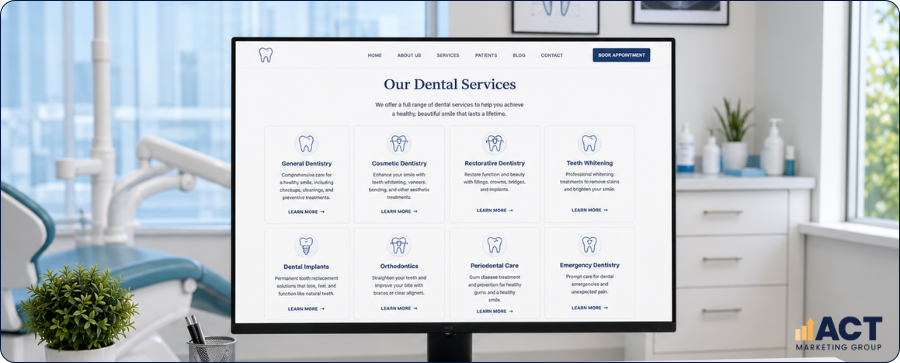
After finding the clinic, patients use the website to decide whether the practice fits their needs. Most want to know whether the service they need is available, who may provide their care, where the clinic is located and how they can arrange an appointment. A useful website allows people to find this information at their own pace. Clear navigation, readable pages and visible contact options support customer engagement without placing pressure on the reader.
Mobile usability is increasingly important because many local dental searches happen on phones. Clickable telephone numbers, simple forms and easy-to-use booking buttons can improve customer satisfaction while reducing avoidable administrative enquiries.
Service Pages Should Explain the Decision Process
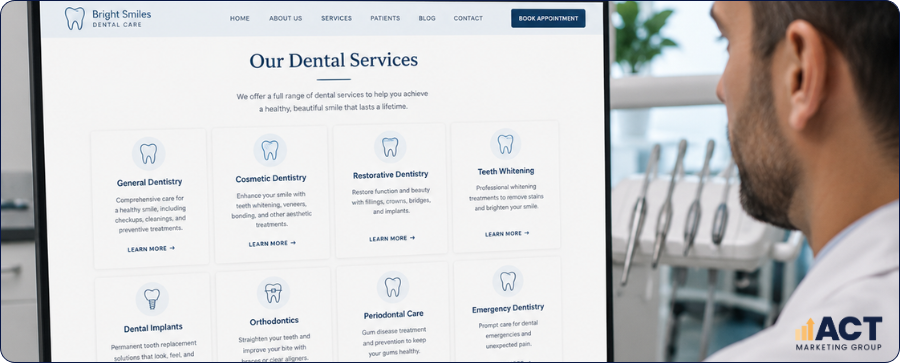
Service pages form an important part of content marketing because they connect search visibility with patient decision-making. A useful page explains what the service involves, why an assessment may be needed and which factors could influence treatment planning. For example, a dental implant page should not suggest that every patient is suitable. It may explain that suitability depends on oral health, available bone, medical considerations, treatment goals and findings from a clinical examination.
This approach supports consumer trust because it helps patients understand the process instead of presenting treatment as a standard product. It also gives the marketing department and clinical team a clearer framework for compliant content development.
Practitioner Profiles Build Professional Confidence
Practitioner profiles often influence whether a patient feels comfortable contacting the clinic. They can explain qualifications, professional roles, clinical interests, languages spoken and the practitioner’s approach to communication.
Profiles should remain specific, factual and restrained. Statements such as “has an interest in preventive and restorative dentistry” may be appropriate where they accurately describe the practitioner’s work, but the wording must not imply specialist registration, advanced qualifications or superior competence that the practitioner does not hold. Unsupported descriptions such as “leading dentist”, “best cosmetic dentist” or “specialist in cosmetic dentistry” should not be used.
Human connection still matters even as artificial intelligence and digital systems become more common. A clear profile helps the patient understand who may provide their care without relying on promotional language, testimonials or claims about expected outcomes.
Reviews Influence the Verification Stage
Independent reviews commonly influence patients after they have already found a clinic through search or referral. People may look for patterns involving communication, punctuality, reception processes, cleanliness and the general experience of attending the practice.
Dental clinics must not create fake or misleading reviews, arrange for others to create them, or edit feedback in a way that misleads patients. Feedback requests should use a consistent process, should not ask patients for a particular rating and should not offer a benefit that is conditional on providing a favourable review. Any incentive offered for feedback requires careful compliance review because it may affect how patients interpret the resulting reviews.
A patient may independently publish a review on a third-party platform, but the clinic must not reuse recommendations or positive statements about the clinical aspects of its dental services in advertising, paid media, website banners or promotional social media posts. Comments limited to non-clinical matters, such as customer service or communication, may not meet AHPRA’s definition of a testimonial, but they must still be accurate, not misleading and reviewed before use. Public responses should avoid confirming that the reviewer attended the practice or revealing personal or clinical information.
Pricing Information Reduces Avoidable Hesitation
Cost is a significant consideration in the dental customer journey. Although a final treatment fee cannot always be confirmed before an examination, a complete absence of pricing information may encourage patients to continue comparing other clinics.
A practical pricing page can explain how fees are determined, what an initial appointment includes and when a written estimate will be provided. Where the clinic publishes a fixed fee, starting price or indicative range, it should clearly state the service components included, likely additional costs, relevant limitations and the circumstances that may change the final fee. Headline pricing should not create the impression that a complete course of treatment is available for that amount, when necessary, components are charged separately.
Any discount, package or complimentary inclusion should include clear eligibility conditions, limits, expiry dates, inclusions and exclusions. Accurate pricing communications support consumer trust and reduce the risk of patients misunderstanding an offer.
Booking Convenience Can Determine the Final Choice
When two clinics appear equally suitable, convenience may become the deciding factor. Patients can be influenced by opening hours, parking, appointment availability, telephone access and the simplicity of the booking process. Online booking should reflect the clinic’s actual systems. When a form submits a request rather than confirming an appointment, the page should state that a team member will contact the patient to confirm the time.
AI-powered chatbots, virtual assistants and AI assistants may help answer basic administrative questions, but they should not provide personalised dental advice, assess emergencies or replace communication with an appropriately qualified team member. The clinic should limit the personal and health information collected through these tools, disclose how information is handled and give patients with urgent, complex or sensitive concerns a clear way to contact the practice directly.

Helpful Content Supports Early Research
Not every website visitor is ready to book. Some people are comparing treatment options, researching a symptom or deciding whether professional assessment may be appropriate. Content creation can support these patients earlier in the journey. Useful articles may explain what happens during an emergency appointment, how a dentist assesses implant suitability or which factors can affect the price of a crown. This form of content production may support search engine optimization when it is based on real consumer needs. Each article should connect naturally to a relevant service page or appointment option without diagnosing the reader or encouraging unnecessary treatment.
Artificial Intelligence Is Changing Search Behaviour
Generative AI is changing how people find and summarise information online. Some patients may use AI powered search tools, virtual assistants or voice search to compare clinics, understand treatments or prepare questions before making contact. These digital marketing trends do not remove the need for an accurate clinic website. Artificial intelligence systems still rely on accessible information, so clear service descriptions, current practitioner profiles and consistent location details remain important.
AI tools can assist marketing teams with topic research, content planning and editing, but AI generated content should always receive human review. Human creativity, clinical oversight and local practice knowledge are needed to confirm that the finished material is accurate and appropriate.
Social Media Supports Familiarity and Recognition
Social media can help patients become familiar with the clinic’s team, environment and communication style. Educational social media posts, appointment updates and general oral health information can support brand loyalty when they remain consistent with the website. Short form video may be useful for showing the clinic location, explaining what happens at a first appointment or providing general preparation advice. Audio content may also support longer explanations, although every format should have a clear purpose within the wider content strategy.
Influencer marketing and niche creators are usually difficult to use safely when promoting regulated dental services. Personal endorsements and treatment stories may create testimonial, privacy or expectation risks, so marketing professionals should not follow these marketing trends without careful review.
Email Supports Ongoing Patient Communication
Email marketing can help a clinic communicate practical information to existing patients. Commercial emails and SMS messages should only be sent where the clinic has the consent required by Australian spam laws, clearly identifies the sender and provides a functional way for recipients to unsubscribe. Appointment reminders that are purely administrative may be treated differently from promotional messages, so clinics should separate service communications from marketing campaigns where practical. Read our guide to Rocket Email Marketing for practical guidance on building compliant lists, planning campaigns and measuring engagement.
Email should not be used to create pressure around treatment decisions. Commercial email and SMS marketing campaigns must identify the sender, explain the promotional purpose clearly and include a functional unsubscribe facility. The clinic must action valid unsubscribe requests within the period required by the Spam Act and ensure that its agency, software provider and internal marketing team use the same suppression records.
First-party data may help the clinic improve the relevance of its communications, but personal and health information must be handled in accordance with applicable privacy requirements. The practice should collect only information reasonably necessary for its functions, explain how that information will be used, secure it appropriately and avoid using health or treatment information for direct marketing unless the proposed use is lawful and the required consent has been obtained.

Connected Marketing Produces More Consistent Information
A reliable dental marketing strategy requires coordination between marketing teams, clinical practitioners and administrative staff. When these groups work separately, inconsistencies can appear across service pages, fees, opening hours, practitioner profiles and booking instructions.
The marketing department should maintain a documented process for content creation, evidence checking, approval and review. An appropriately qualified practitioner should review clinical statements, but clinical approval does not by itself establish advertising compliance. Claims about treatment benefits, safety, effectiveness, speed or outcomes should also be supported by acceptable evidence and assessed against the National Law’s advertising requirements before publication.
This joined-up approach supports stronger marketing communications across search, social media, paid media and email marketing. It may also save businesses from repeatedly correcting information after patients have already encountered it.
Compliance Must Apply Across Every Channel
Dental advertising must be accurate, not misleading and supported by acceptable evidence where claims are made. Clinics must not use testimonials about the clinical aspects of regulated dental services in advertising, create unreasonable expectations of treatment benefits, encourage unnecessary or indiscriminate use of services, or advertise gifts, discounts or other inducements without clearly stating the applicable terms and conditions. Guarantees, unsupported comparisons and claims about outcomes, safety, speed or effectiveness require particular care.
The same advertising requirements apply to website content, practice-controlled social media, paid media, promotional email, printed materials and other public communications that promote regulated dental services. The approval process should check practitioner titles, clinical and comparative claims, prices and offers, images, testimonials about clinical care, privacy considerations and treatment information before publication.
Compliance is not separate from brand building. Clear and responsible marketing communications can strengthen consumer trust because they allow patients to make decisions using information that is understandable and appropriately qualified.
Have Questions?
We're Here to Help!
Current Marketing Trends Require Selective Adoption
The marketing field regularly introduces new platforms, content formats and automation tools. Virtual reality, augmented reality, AI agents and automated media production may attract attention, but they are not automatically suitable for every dental clinic. The top marketing trends are only useful when they respond to genuine consumer needs. A clinic should ask whether a tool improves access to information, reduces booking friction or supports a better customer experience before committing resources.
Rising costs also make this assessment increasingly important. Marketing campaigns should focus on measurable patient needs and sustainable channels rather than adopting the latest trends simply because competitors appear to be using them.
Building A More Effective Patient Journey
Australian patients choose dentists by comparing a series of trust, relevance and convenience signals. Search visibility may create awareness, but service information, practitioner profiles, reviews, pricing and booking options usually shape the final decision. The most effective marketing efforts connect these touchpoints into one customer journey. The clinic’s brand stands for more when its information remains consistent, useful and professionally restrained across every platform.
A practical first step is to search for the clinic and its priority services, review each public listing, test the website on a mobile device and complete the enquiry process. This can identify outdated information and barriers that may prevent potential customers from contacting the practice.
Strengthen Your Dental Practice’s Online Patient Journey
ACT Marketing helps Australian dental practices improve search engine optimisation, local visibility, content marketing and booking pathways. The focus is on clear information, compliance-aware content and marketing strategy that reflects how patients make decisions online. A useful starting point is to audit one priority service across search results, local listings, website pages, practitioner profiles and enquiry systems. The audit should identify where patients may need clearer information or a simpler next step.
Improving these connected touchpoints can support brand trust and more relevant enquiries without relying on exaggerated claims. The result is a more practical digital presence that helps patients understand the clinic and decide whether to make contact.