

SEO for dentists in Australia is most effective when every important treatment, preventive service and patient concern is matched with a clear search theme and a suitable page on the dental website. Many dental practices publish broad service descriptions, but these pages often fail to reflect the different ways prospective patients search for dental care. A service-to-keyword map gives your practice a practical foundation for dental SEO. It connects relevant keywords with the right pages, reduces competition between similar content and helps search engines understand which parts of your dental practice’s website should appear for particular searches.
Start With the Reason A Patient Is Searching
A useful SEO strategy begins by identifying what a patient wants at the time of the search. Someone entering “family dentist near me” is likely comparing local dental practices, while someone searching for the cause of tooth sensitivity may still be trying to understand a symptom. These searches should not lead to the same type of page. Provider searches usually need a clear location, service summary and appointment pathway, while symptom searches need balanced information that directs the reader towards an appropriate dental assessment without attempting to diagnose the problem online.
Most dental searches fit into practical groups, including choosing a dental clinic, researching a named treatment, looking for preventive dental care, comparing costs or seeking help for an urgent problem. Understanding these differences helps your practice create content that matches the patient’s next decision.
Get a Customized Marketing Strategy for Your Business
Schedule a free consultation to discuss how our digital marketing solutions can help you reach more customers.
Build The Website Structure Before Mapping Keywords
Once search intent is clear, organise the dental website around the services your clinic actually provides. The homepage should introduce the practice, its location and its main areas of care, while individual pages should explain specific dental services in enough detail to support an informed enquiry. A clear structure helps search engines determine which page is most relevant for each search. It also makes the dental practice’s online presence easier for potential patients to navigate, particularly when they are moving between a symptom article, one of the key treatment pages and the contact or booking section.
Assign Core Searches to the Main Practice Pages
The next step is to decide which pages should target the practice’s broadest dental keywords. The homepage will often focus on the main location and a general term such as dentist, dental clinic or family dentist, while category pages can target preventive care, emergency dentistry or cosmetic dentistry. This approach prevents every page from competing for the same phrase. It also makes the overall SEO strategy easier to manage because each page has a defined purpose, a primary keyword theme and a clear relationship to the rest of the dental practice’s website.
Separate Preventive Care from Treatment Searches
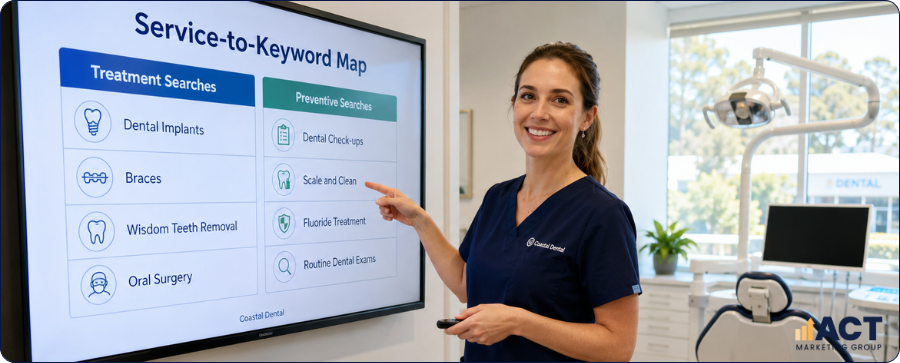
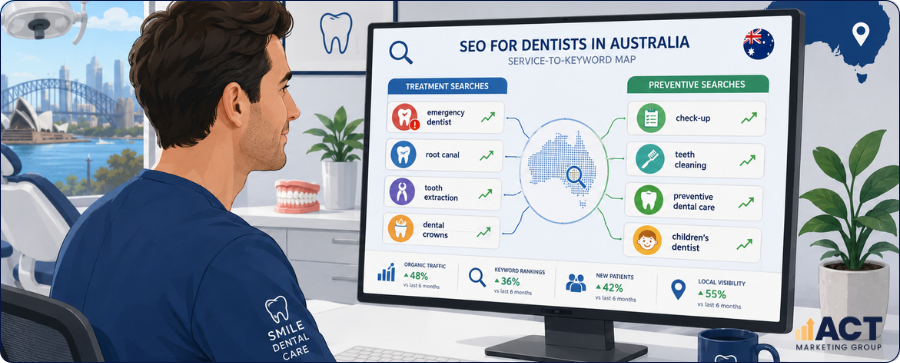
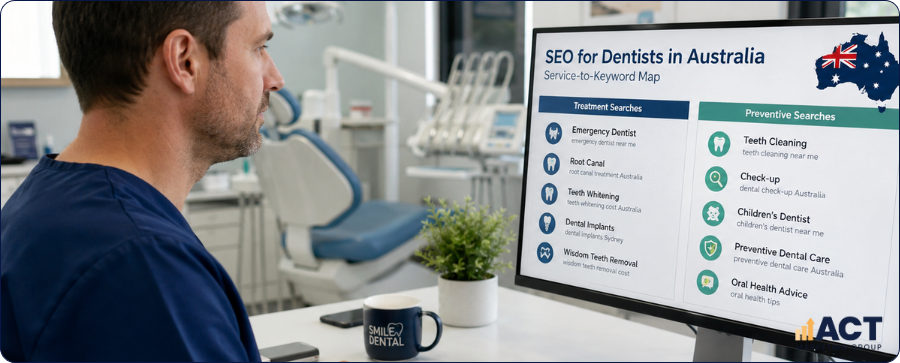
Preventive searches should have a distinct place within the keyword map. Patients searching for dental check-ups, professional cleaning, fluoride treatment, sports mouthguards or children’s dental care have a different need from those researching dental implants, dental crowns or root canal treatment.
Preventive content can support both new patients and existing patients by explaining how the practice approaches routine assessment, oral hygiene and ongoing dental care. It should not state or imply that every patient requires the same treatment or fixed appointment interval. The appropriate timing and type of preventive dental care depend on the patient’s oral health, history, risk factors and clinical assessment.

Give Each Treatment a Clear Keyword Theme
Treatment pages form the centre of a service-to-keyword map. Each page should focus on one main dental service and use supporting dental keywords that reflect the questions patients commonly ask before deciding whether to contact the practice. For example, a dental implants page may cover assessment, treatment stages, suitability, healing considerations and the factors affecting fees. A dental crowns page may explain when a crown may be considered, the steps involved, possible alternatives and the importance of a clinical examination.
The same principle applies to teeth whitening, fillings, dentures, extractions, clear aligners and other dental services online. Each page should explain the service accurately rather than relying on repeated keywords or unsupported claims about being the best dentist for a particular treatment.
Connect Symptom Searches with Relevant Services
Many prospective patients search for a symptom before they know which dental service they may need. Common examples include toothache, bleeding gums, sensitivity, a chipped tooth, a loose adult tooth or discomfort when biting. Symptom-based content can help a dental practice appear in search results earlier in the patient journey. The page should describe possible causes in general terms, explain when prompt dental care may be appropriate and connect the reader with relevant services without presenting a definite diagnosis.
Match The Page Format to Search Intent
A strong dental SEO strategy does not treat every keyword as an article topic. Some phrases are best served by a treatment page, while others need a detailed guide, a short answer, a location page or a clear contact page. Patients searching for an emergency dentist usually need opening hours, contact details, location information and guidance on what to do next. Patients researching dental implant costs or teeth whitening options are more likely to need an explanation of the factors that affect suitability, treatment planning and fees.
Keyword research should therefore consider the type of result that appears on search engine results pages and make use of specialised keyword research tools to understand search volumes, related phrases and potential opportunities. Looking at the search results can show whether search engines favour service pages, articles, local listings or comparison content for a particular query.
Strengthen Local SEO With Real Practice Information
Local SEO helps a dental practice appear for searches connected with a geographic area. This includes phrases such as dentist near me, family dentist in a suburb, emergency dentist in a city or dental implants near a particular location. An accurate and verified Google Business Profile is an important part of local search visibility. The practice name, address, phone number, opening hours, service categories and website details should be complete and consistent with the dental website. A complete profile may support local SEO efforts and help search engines understand the practice, but it does not guarantee where the practice appears in local search results.
Improve Each Page Without Overloading the Copy
On page SEO involves improving visible content and basic page details so the purpose of the page is clear. The primary phrase should appear naturally in the title, main heading, opening section and selected subheadings, but it should not be forced into every sentence. The page title and description should accurately explain what the reader will find. Headings should divide the information into logical stages, while internal links should connect the page with related dental services, symptom information and the booking process.
Images should use descriptive file names and alternative text that accurately explains what the image shows. Before and after images require documented patient consent and careful clinical, privacy and advertising review because they may create an unreasonable expectation of beneficial treatment or encourage unnecessary dental services. Any images used should be genuine, presented with comparable lighting, angles, framing and conditions, and should not imply that the displayed outcome is typical, guaranteed or available to every patient.
Support The Content with a Sound Technical Foundation
Technical SEO focuses on whether search engines can access, understand and display the website correctly. It includes page speed, mobile usability, secure browsing, working links, clear navigation and the removal of duplicate or broken pages. A technical SEO audit can identify problems that limit search visibility even when the written content is useful. Common issues include slow images, outdated page addresses, missing titles, broken contact forms and several pages targeting the same keyword.
Structured data can help search engines understand details such as the dental practice type, address, opening hours and page content. It should match information that is visible and accurate on the dental practice’s website and must not contain unsupported clinical, promotional or comparative claims. Correct structured data may assist interpretation, but it does not guarantee a particular search engine ranking, display feature or position on search engine results pages.
Use Supporting Content to Build Search Visibility
Content marketing can extend the keyword map beyond the main service pages. Articles can answer questions about preventive care, treatment stages, recovery considerations, costs, suitability and the differences between common treatment options. This supporting content should link back to key treatment pages and help patients understand when a professional assessment may be appropriate. It should not repeat the same service description across multiple articles or encourage unnecessary use of dental services.
Social media marketing may help distribute useful practice information, including video content that benefits from YouTube SEO for Australian creators, but it does not replace dental search engine optimisation. Google Ads may provide faster paid visibility when campaigns are eligible, adequately funded, appropriately targeted and compliant with health advertising requirements. Organic traffic from dental SEO may build gradually as the dental website becomes more complete, useful and relevant.
Build Authority Through Relevant Links
High-quality backlinks from relevant and trustworthy sources may support the prominence and discoverability of a dental website, but no individual link guarantees improved search rankings. Appropriate sources may include professional associations, established local organisations, reputable directories and genuine dental industry relationships. Dental practices should avoid purchased, automated or unrelated links intended mainly to manipulate search results.
Manage Reviews Without Turning Them into Advertising Claims
Patient reviews can influence how potential patients assess local dental practices, particularly when they appear on independent platforms. Dental practices may encourage patient reviews through a neutral and consistent process, but they should not pressure patients, suggest comments about clinical care or treatment outcomes, or selectively invite only patients expected to provide positive reviews. Any process used to encourage patient reviews should also comply with privacy obligations, Australian Consumer Law and the relevant review platform’s rules.
Patient reviews that refer to symptoms, diagnosis, treatment, clinical care, practitioner skill or treatment outcomes must not be used in the dental practice’s website, advertisements or social media marketing as patient testimonials. Reviews limited to non-clinical matters, such as customer service or communication, are not necessarily prohibited testimonials; however, editing, selectively publishing or presenting positive reviews in a misleading way may still breach Australian advertising requirements.
The dental practice may respond professionally to patient reviews on the platform where they appear, but each response must protect patient privacy. Staff should not confirm that the reviewer is a patient, identify the person from practice records, discuss dental care or treatment details, or disclose personal or health information in a public reply. Where follow-up is appropriate, the response should invite the person to contact the dental clinic through a private channel.
Review Compliance Before Publishing Dental Content
Every page should be checked for accuracy, balance and compliance before publication. Dental marketing must not be false, misleading or deceptive; offer a gift, discount or other inducement without clearly stating the applicable terms and conditions; use prohibited patient testimonials; create an unreasonable expectation of beneficial treatment; or directly or indirectly encourage the indiscriminate or unnecessary use of dental services.
Phrases such as pain-free, permanent results and guaranteed smile should not be used where they imply certainty, remove material qualifications or create an unreasonable expectation of beneficial treatment. A comparative term such as best dentist should not be used unless the dental practice can substantiate the exact claim with clear, objective and acceptable evidence. In most dental marketing, factual descriptions of qualifications, dental services, experience and location are more appropriate. Suitability, risks and results should be described as depending on the patient’s circumstances and clinical assessment.
Offers and pricing statements also require care. Any conditions, limits, eligibility requirements, inclusions and exclusions should be clear and readily accessible, while treatment costs should be presented as dependent on individual needs where appropriate. Claims about treatment effectiveness, benefits, safety, comfort, speed, durability or likely outcomes should only be published when the dental practice holds acceptable evidence that directly supports the precise wording used.
Turn The Keyword Map into a Publishing Plan
Once the service themes are defined, prioritise pages according to patient demand, current website gaps, treatment relevance and the practice’s capacity to accept suitable enquiries. Most dental practices benefit from improving their main service pages before publishing a large volume of general articles. A sensible first phase may include the homepage, general dentistry, preventive care, emergency dentistry and several key treatment pages. The second phase can add symptom content, cost guides, treatment comparisons and other topics identified when you perform keyword research, including more specific long-tail keyword phrases for dental services.
The keyword map should record the target page, primary phrase, supporting terms, search intent, internal links and publication status. Every page promoting dental services should receive an advertising compliance review before publication, while pages containing treatment descriptions, risks, outcomes, comparisons or clinical claims should also receive approval from an appropriately qualified clinical reviewer.
Have Questions?
We're Here to Help!
Coordinate SEO With the Wider Dental Marketing Plan
Dental SEO should form part of the overall SEO strategy and wider dental marketing plan. It can work alongside Google Ads, referral activity, email communication and selected social media marketing without requiring every channel to use the same message. An SEO agency should understand how these channels interact. Dental SEO services should not be measured only by traffic when the practice also needs suitable enquiries, clear patient information and a website that supports the appointment process.
Measure SEO Performance Against Relevant Enquiries
Search rankings provide useful information, but they do not show the full value of SEO services. A page may rank for a broad phrase and attract substantial organic traffic without producing relevant enquiries for the practice. Measure SEO performance by service category and patient action. Useful indicators include calls, online bookings, contact forms, visits to key treatment pages, Google Business Profile actions and the quality of enquiries attributed to organic search. Search visibility should also be reviewed across local search results, treatment phrases and preventive topics. If two pages compete for the same keyword, they may need to be combined, rewritten or assigned more clearly separated purposes.
Understand What Influences SEO Cost
SEO cost depends on the size and condition of the website, the number of services being promoted, the level of local competition and the amount of technical and content work required. A small dental clinic with a straightforward website may need a different scope from a larger practice with multiple locations and extensive treatment pages. The cost may also be influenced by whether the practice requires keyword research, content writing, local SEO, technical SEO, on page SEO, link review or regular reporting. These activities should be connected to the practice’s priorities rather than bundled together without a clear reason.
Refine The Map as Search Behaviour Changes
A service-to-keyword map should not remain unchanged after publication. Search behaviour, patient questions, treatment priorities and competition can shift over time, making regular review an important part of dental search engine optimisation. Search data may show that potential patients searching for a treatment use different language from the terminology used by practitioners. Updating headings, explanations and supporting keywords can improve search rankings while also making the content easier to understand.
Build A Clearer Dental SEO Strategy
A service-to-keyword map connects the needs of potential patients with the dental services available at your clinic. It provides a structure for deciding which pages to create, which relevant keywords to target and how each page should guide the reader towards an appropriate next step. Begin by reviewing the existing dental practice’s website and assigning one clear search theme to every important page. Then identify gaps across preventive care, emergency needs, symptoms, cosmetic dentistry, restorative treatment and other services genuinely provided by the practice.
A successful dental practice does not need to appear for every possible search. It needs stronger search visibility for relevant services, locations and patient needs that match the care the team is equipped to provide.
Strengthen Your Dental Search Visibility
ACT Marketing develops practical dental SEO strategies for Australian practices that want clearer website structures and more relevant local search visibility. The process can include keyword research, dental website SEO, content planning, local SEO, on page SEO and a technical SEO audit. A structured approach to SEO for dentist searches can support the practice’s online presence while keeping the content useful, measured and aligned with Australian dental advertising requirements.