

Dental Website SEO Architecture: Structuring Services, Locations, and Supporting Content is the foundation of a dental website that helps prospective patients find the right treatment, understand the practice and take the next step. Without a clear structure, even well-written website content can become difficult for patients and search engines to navigate. For dental practices, effective architecture means organising dental services, location pages and supporting content around genuine patient needs. It also supports a clearer online presence, accurate treatment information and direct pathways to a dental appointment.
Start With the Search Journeys That Matter to Your Practice
Before creating or restructuring pages, define the types of patients your dental practice wants to reach. A general dental clinic, an emergency dentist, an implant-focused practice and an Invisalign dentist may serve the same area, but their priority searches and patient decisions will differ. This first step shapes the entire dental SEO strategy. It helps you decide which pages deserve space in the main navigation, which services need detailed content, and which topics should be covered through supporting articles rather than new sales pages. Most patient journeys fit into a small number of groups:
People searching for a dentist near their home or workplace
Patients looking for a specific treatment
People comparing local dental practices
Existing patients seeking practical information
Patients who need urgent dental care
The architecture should reflect these journeys instead of being built around a long list of keywords. Keyword research is still important, but the purpose is to understand what patients search for and how those searches relate to real dental services.
Get a Customized Marketing Strategy for Your Business
Schedule a free consultation to discuss how our digital marketing solutions can help you reach more customers.
Give Every Page One Clear Search Purpose
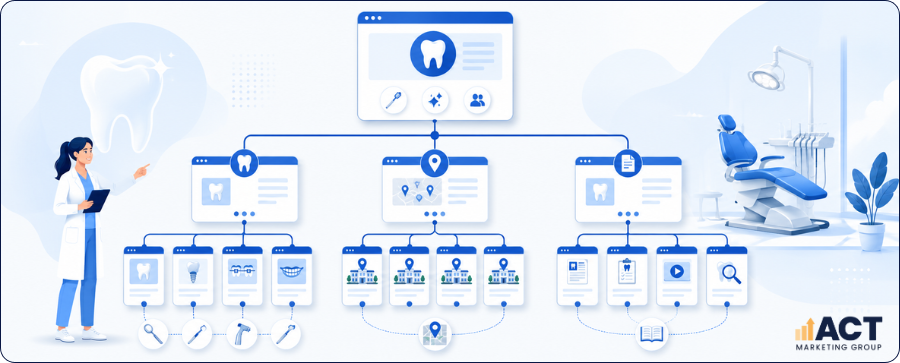
Once the main patient journeys are defined, assign one clear purpose to each page. A dental website is easier to manage when the homepage, service pages, location pages and articles are not trying to rank for the same relevant keywords. The homepage should explain what the practice offers, where it is located and why a patient may consider booking. It should then direct visitors to the most important dental services, location information and appointment options.
A service page should focus on a treatment or closely related group of treatments. A location page should explain the practice’s connection to a real clinic or service area, while an article should answer a specific informational question and guide the reader towards an appropriate next step. This separation improves search visibility because search engines can more easily understand the role of each page. It also helps relevant visitors find useful information without moving through several pages that repeat the same points.
Build Service Hubs Around The Practice’s Main Treatment Areas
The service section should form the core of the dental practice’s website. Broad service hubs can introduce major areas of care, while detailed pages can address treatments that involve separate questions, costs, suitability factors or booking decisions. For a general dental clinic, the main hubs may include preventive dental care, restorative dentistry, cosmetic dentistry, emergency dentistry and children’s dentistry. A larger practice may also require dedicated sections for dental implants, orthodontics, oral surgery or sedation.
Preventive and General Dental Care
A preventive care hub can cover examinations, professional cleaning, oral health advice, X-rays and ongoing maintenance. These services often support both new patients and existing patients, so the page should explain how routine care fits into the practice’s broader approach. Separate pages may be useful for services with clear search volume and different patient needs. However, creating individual pages for every small variation can make the website harder to use and may weaken overall SEO performance.
Restorative and Complex Treatment
Restorative treatment pages may include fillings, crowns, bridges, root canal treatment and dentures. Dental implants may need a separate page because patients usually want more detail about assessment, stages, suitability, recovery and costs. The page should explain the process in measured terms without suggesting that one treatment is suitable for everyone. Clear information helps potential patients prepare for a dental appointment and gives dental professionals a stronger basis for discussing individual treatment options.

Cosmetic and Orthodontic Services
Cosmetic treatment pages should be organised around actual services rather than broad promises. Teeth whitening, veneers and clear aligner treatment may each require separate pages when they involve different assessments and patient questions. A page targeting the search term “Invisalign dentist” should explain who may be suitable, what the assessment involves and how treatment is monitored. The term should not be presented as a formal professional title, and the page should not use unsupported claims such as “best dentist” or suggest a guaranteed outcome.
Create Detailed Service Pages Only Where They Add Value
After the main hubs are in place, assess which dental services need dedicated pages. A new page is justified when the treatment has a distinct patient intent, enough useful information to support a decision and a clear action such as requesting an assessment. A strong service page should explain what the treatment is, why it may be considered, how the practice approaches assessment and what factors may affect recommendations. It should also answer practical questions about timing, recovery, appointments and follow-up care where appropriate.
Pages should not be created simply because a term appears in keyword research. Several weak pages targeting slight variations of the same search can repeat information, divide internal links and make the dental practice’s website harder to maintain or understand in search engine results pages.
Structure Location Content Around Genuine Practice Operations
Once service pages are organised, location content should show where the practice operates and which areas it realistically serves. Accurate and consistent information across the dental website, Google Business Profile, Google Maps and trusted listings helps search engines understand the practice and supports its appearance in relevant local search results. A dental clinic with one physical location usually needs one detailed location page. That page should include the address, opening hours, contact details, parking information, public transport options, accessibility information and the dental services available at the clinic.
Give Each Physical Clinic Its Own Page
Dental practices with several clinics should create a separate page for each real location. Every page should contain details specific to that branch rather than repeating the same text with only the suburb name changed. A location page can include the dental professionals who work there, dental services offered, opening hours and directions. Practitioner titles, qualifications and areas of practice must be accurate and must not imply specialist registration that the practitioner does not hold. The page should link to relevant service pages so patients can confirm whether the dental clinic provides the care they need.
Use Suburb Pages Selectively
A practice does not need a page for every nearby suburb. Suburb pages should only be created when they provide useful local information and represent a genuine area served by the clinic. Publishing many near-identical pages can create weak website content and confuse potential patients about where the practice is located. A better approach is to build one strong clinic page and mention nearby service areas in a clear, accurate way.
Keep Google Business Profile Details Consistent
The business name, physical address and phone number shown on the dental website should be accurate and consistent with the verified Google Business Profile. Opening hours, dental appointment links, temporary closures and service information should also be reviewed regularly. This consistency supports local search results and helps patients find the clinic through Google Search and Google Maps. It also reduces the chance of people calling the wrong number or arriving outside normal hours.
Improve your local presence with our guide to Google Business Profile Optimisation for Dentists, covering the details that help patients find and contact your practice.
Connect Services and Locations Without Duplicating Content
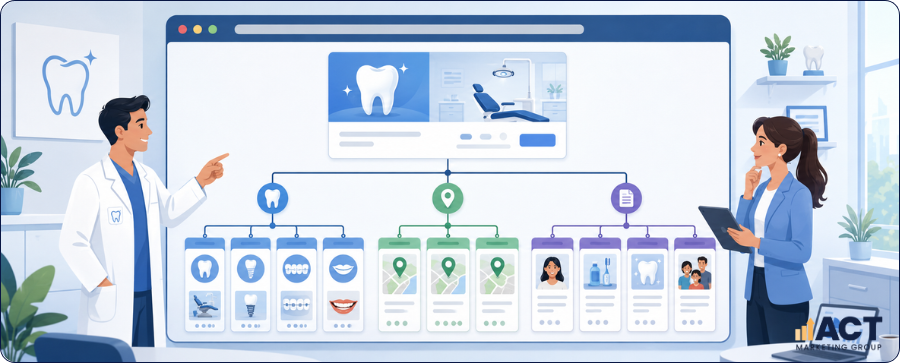
Service and location pages should work together, but they should not repeat each other. The service page should provide detailed treatment information, while the location page should explain where that treatment is available. For a group with several dental clinics, this distinction becomes important. Some treatments may be offered at every clinic, while dental implants, sedation or orthodontic services may only be available at locations with suitably trained practitioners, appropriate facilities and any required registrations or endorsements.
Each service page can identify the clinics that provide the treatment. Each location page can then link to the services available at that branch, giving patients a direct path from local search to relevant care. This approach supports both dental search engine optimisation and patient experience. It also helps reception teams receive more suitable enquiries because the website makes service availability clearer before a patient calls.
Use Supporting Content to Answer Questions Before Patients Book
Once the main service and location structure is stable, supporting articles can address the questions patients ask before making an appointment. These articles should support the main pages rather than sit as disconnected blog posts. Useful topics may explain what to expect during a dental implant consultation, when emergency dental care may be needed or how to prepare for a child’s first dental visit. Each article should answer the question directly and then link to the most relevant service or booking page.
Supporting content can also improve online visibility for searches that are too specific for a main service page. This allows the practice to reach prospective patients earlier in their decision process without overloading treatment pages with unrelated detail. Articles should remain factual and practical. They should not diagnose a condition, guarantee a result or replace advice from a dental professional who has assessed the patient.
Plan Content Clusters Around Real Patient Questions
A content cluster is simply a connected group of pages covering one treatment area. The main service page acts as the central page, while supporting articles answer narrower questions and link back to it. For dental implants, supporting topics might include implant assessment, recovery planning, alternatives to implants and factors that influence treatment time. For an emergency dentist page, related articles might cover chipped teeth, dental swelling or what to do after a tooth is knocked out.
This structure helps search engines understand the relationship between pages. It also gives patients several useful entry points into the website while keeping the main service page focused on treatment and booking intent. Perform keyword research before choosing article topics but assess every term against the needs of the practice. Search volume alone does not make a topic useful if it attracts visitors who are unlikely to need the clinic’s services.
Make Internal Links Part of The Page Structure
Internal links connect the pages of the dental website and help users move from general information to a relevant service or dental appointment. They should be included as part of the content plan rather than added after publication without a clear purpose. The homepage should link to key services and the main location page. Service hubs should link to detailed treatment pages, while articles should point readers towards the most relevant service, location or contact page.
Use clear link wording that describes the destination. Phrases such as “learn about dental implant assessment” or “view our emergency dental services” are more useful than vague instructions such as “click here”. Internal links should be reviewed when pages are renamed, removed or combined.
Have Questions?
We're Here to Help!
Keep URLs and Navigation Simple
A clear dental website design makes important pages easy to reach without creating a crowded menu. The main navigation should focus on the sections patients need most, such as services, the dental team, locations, patient information and contact details. URLs should also be short and descriptive. A page about dental implants might use /dental-implants/, while a clinic location page may use /locations/canberra/.
Avoid long URLs filled with categories, dates or unnecessary words. Simple naming makes the structure easier for the practice to manage and easier for patients to understand when they see a page in search results. The navigation and URL structure should follow the same logic. If a page belongs within restorative dentistry, its position on the website should make that relationship clear.
Apply Technical SEO Without Overcomplicating the Website
Technical SEO supports the structure by helping search engines access, understand and display the dental website correctly. For most dental practices, the priorities include mobile usability, suitable page speed, HTTPS security, crawlable navigation, correct indexing controls and a clear site structure. Google PageSpeed Insights can help identify slow images, large files and other page issues. However, the goal is not to chase a perfect score; it is to provide a stable website that loads quickly enough for patients to find information and book.
On page SEO should also be applied consistently. Each page needs a clear title, one main heading, useful subheadings, a descriptive page summary and content that matches the search intent. Technical checks should include missing pages, redirect problems, duplicate titles and broken links. These issues can weaken SEO efforts even when the content itself is sound.
Strengthen your website structure with our guide to On-Page SEO tips for Dental Clinics, including practical ways to improve service pages, suburb targeting and search visibility.
Keep Reviews and Promotions Separate from Clinical Claims
Online reviews can help prospective patients assess a dental practice, but testimonials about clinical care, practitioner skill or treatment outcomes must not be used in advertising controlled by the practice. Patient reviews should not be copied, embedded or reposted on the dental website, paid ads or social media marketing when they refer to clinical experiences or results. The dental website should focus on accurate service information, practitioner details and practical patient guidance. Claims about treatment benefits, speed, comfort, safety, results or superiority must be accurate, supported by acceptable evidence and presented without creating unrealistic expectations or encouraging unnecessary dental care.
Paid ads, Google Ads and social media marketing may support a wider dental marketing strategy, but they do not replace a clear website structure. Advertising is more likely to produce relevant enquiries when visitors arrive on a page that directly matches the service and location promoted. A dental marketing company, dental SEO agency or dental SEO company should therefore review the website architecture before increasing campaign activity. Sending more visitors to unclear or duplicated pages rarely addresses the underlying problem.
Measure Whether the Structure Supports Patient Enquiries
Search rankings are useful, but they are not the only measure of SEO performance. A dental practice should also assess whether patients find the correct service, understand where it is available and complete a meaningful action. Track calls, booking forms and appointment requests by landing page. Review which articles lead visitors to service pages, which locations receive suitable enquiries and which pages appear in search results but fail to attract relevant visitors.
Local search rankings should also be considered alongside Google Business Profile activity. Calls, direction requests, website visits and booking actions can provide a broader view of how the practice appears in local search. SEO cost should be assessed against whether the dental SEO services improve the practice’s online presence and support relevant new patient enquiries.

Maintain the Architecture as the Practice Changes
A dental website should not be treated as a finished project. Services, practitioners, locations, opening hours and patient needs change, so the structure requires regular review. A quarterly check can identify outdated practitioner pages, duplicate content, missing internal links and services that are no longer available. It can also reveal opportunities to improve pages that attract search traffic but do not give patients a clear next step. When a service is added, decide whether it belongs on an existing page or needs a dedicated page. When a clinic relocates, update the website, Google Business Profile and all key business listings at the same time.
Strengthen Your Dental Website SEO Architecture
A useful dental website SEO architecture connects services, locations and supporting content around real patient needs. Service hubs explain the practice’s main treatment areas, detailed pages support distinct decisions, location pages represent genuine operations and articles answer questions that arise before booking. Start by mapping every current page and assigning it one purpose. Remove overlap, repair broken links and make sure each important service can be reached through a clear path from the homepage, relevant location pages and supporting articles.
ACT Marketing can help dental practices develop a practical dental SEO structure based on their services, locations and growth priorities. The result should be a website that is easier to manage, clearer for patients and more likely to attract relevant local enquiries.