

ChatGPT Ads currently reach only eligible users on ChatGPT’s ad-supported Free and Go plans. They do not appear for Plus, Pro, Business, Enterprise or Edu accounts, so advertisers cannot assume all ChatGPT users are reachable. Even on eligible accounts, ads appear only in suitable conversations.
OpenAI’s decision to introduce ads creates another digital marketing channel for businesses, but access to an audience does not guarantee a useful customer enquiry. Before moving budget from Google Ads, SEO or other channels, consider who can see a placement, which conversations qualify and how results will be measured.
ChatGPT Ads Are Available In Australia, But Reach Has Limits
As of October 2026, Australia is on OpenAI’s Ads Manager country list, but ChatGPT’s free tier and Go plan are the only account plans eligible to see ads. Accounts identified as belonging to users under 18 are excluded, while Free users can also choose an ad-free option with reduced usage limits.
OpenAI reported on 21 October 2026 that more than 1.2 billion people used ChatGPT weekly and over 100,000 advertisers had run campaigns worldwide. Neither figure tells you how many Australian adults use eligible plans or will encounter a relevant advertisement.
Availability: Australian businesses can create self-service advertiser accounts, subject to verification, billing and review.
Audience: Only eligible Free and Go users can see ads; paid ad-free accounts and identified minors cannot.
Local relevance: Location options vary; check whether ACT or Canberra targeting is supported.
Practical implication: Forecast conservatively until your account shows reach, costs and qualified enquiries.
Get a Customized Marketing Strategy for Your Business
Schedule a free consultation to discuss how our digital marketing solutions can help you reach more customers.
Research Intent Versus Immediate Demand
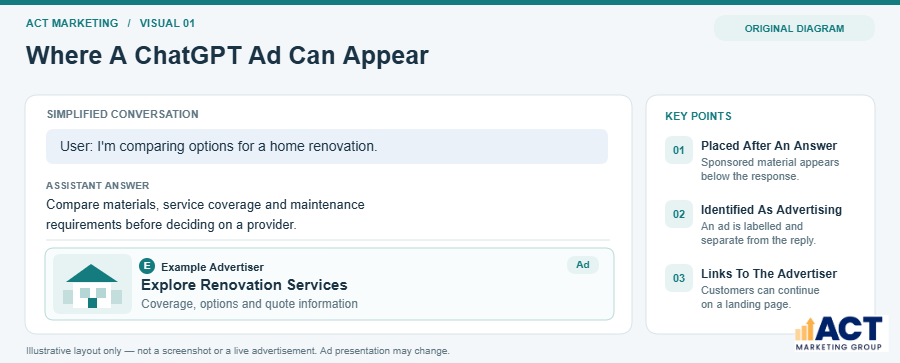
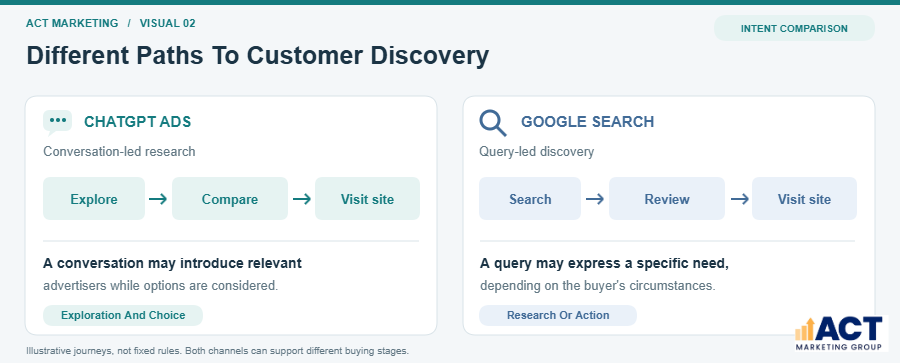
A Canberra renovator may be comparing materials rather than searching for a contractor by name. A home-improvement ad may reach that person during research, whereas a Google search for “emergency plumber Canberra” may indicate more immediate booking intent.
The distinction is also reflected in early advertiser messaging. “Showing up in ChatGPT helps us build consideration at that moment,” says Alec Shao, Performance Marketing Manager at Newegg; consideration is valuable, but it is not a sale.
Your Customer’s Decision Process Should Determine Channel Fit
Start with the customer’s buying journey rather than a platform presentation. ChatGPT advertising may fit offerings customers compare or research over several steps, especially when useful information reduces uncertainty.
Fit changes when customers act immediately, service areas are narrow or advertising rules limit what you can promote. High-intent search campaigns may better reach buyers who already know what they need. Use the following framework, not forecasts.
| Business Situation | Where ChatGPT Ads May Help | What To Prioritise First |
|---|---|---|
| Ecommerce with comparison-heavy products | Introduce an option while users compare features and suitability | Clear product pages, margins and stock accuracy |
| B2B software or professional services | Build awareness during early solution research | Useful explanatory content and lead qualification |
| Canberra home renovation services | Reach people planning longer projects | Confirm local targeting and enquiry quality |
| Emergency services with urgent demand | Potentially limited research window | Local SEO and high-intent search campaigns |
| Regulated health or financial services | Possible only where approved | Check OpenAI category eligibility and Australian rules |
Budget Decisions Need More Than A Cost-Per-Click Estimate
Once you have a suitable use case, set a commercial threshold before choosing a bid. OpenAI supports Views (impression-based buying), Clicks (valid-click buying) and conversion-optimised campaigns; conversion optimisation does not mean you pay only when a customer converts.
OpenAI’s 2026 guidance lists A$25 as the minimum daily budget for AUD-billed accounts, an account setting rather than a recommended test budget or expected return. Daily budgets are averages, so review pacing, ad spend and account limits in Ads Manager before launch.
| Campaign Objective | Billing Approach | Useful When |
|---|---|---|
| Views | Cost per 1,000 impressions (CPM) | You need measured reach rather than immediate leads |
| Clicks | Cost per valid click (CPC) | Website visits are an appropriate first signal |
| Conversions | Optimised delivery with supported click or impression billing | Reliable event tracking and sufficient data are in place |
Work Backwards From A Viable Customer Acquisition Cost
Consider an illustrative service business earning A$800 in contribution after direct costs per new client, with one sale for every four qualified enquiries. Its theoretical break-even acquisition cost is A$800 per sale, or A$200 per qualified enquiry, before overheads and a required profit margin; the actual spending threshold should therefore be lower.
This is a decision tool, not a ChatGPT Ads performance benchmark. If expected acquisition costs exceed the business’s acceptable level, a smaller trial—or no trial—may be more sensible than raising bids to chase visibility.
Ad Relevance And Landing Pages Must Work Together
Even a reasonable budget will struggle if the creative answers the wrong question. OpenAI recommends specific, benefit-led copy supported by imagery and a landing page that matches the promise. Testing distinct messages is more useful than repeating the same sales claim.
For Australian advertisers, focus on purchase considerations such as service coverage, suitability, prices, delivery or qualifications. ChatGPT Ads can introduce a business within AI conversations, while SEO helps people find its pages through search engines; neither secures visibility in the other. Paid placements also do not guarantee organic AI visibility.
Match the context: Show the offering’s role in the customer’s problem.
Be precise: State limitations, service areas and genuine differentiators.
Reduce friction: Send visitors to a suitable page, not automatically the homepage.
Make action clear: Offer a quote request, purchase path or useful resource appropriate to their stage.
Support organic visibility: Maintain accurate service information and content that independently answers customer questions.
Measurement Must Show Business Value, Not Just Attention
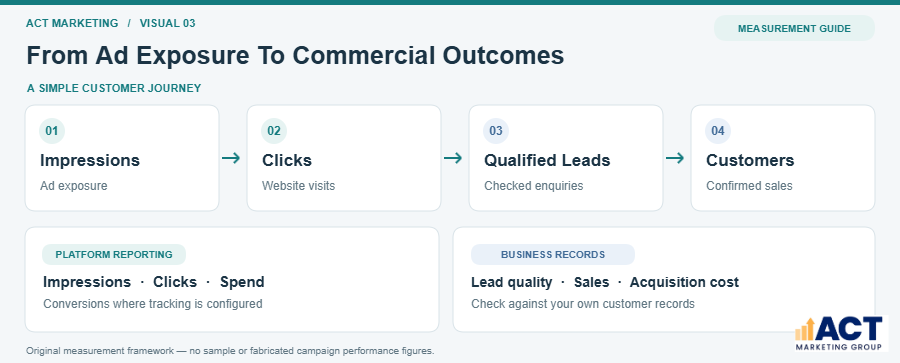
Once a visitor reaches your website, the question shifts from exposure to outcomes. OpenAI’s reporting includes impressions, clicks, ad spend, click-through rate and conversions; tracking parameters and its Conversions API can help connect campaigns with actions on your site.
Check conversion tracking implementation before launch: make sure your website records brochure downloads, form submissions and genuine sales enquiries correctly. Review lead quality with the team taking enquiries, because low-cost clicks can still produce expensive customers. For longer sales cycles, record what happens after the first enquiry.
Track the journey: Use consistent UTM tags, suitable conversion tracking and consent-aware analytics.
Check attribution: Compare Ads Manager reporting with your own analytics and customer records; they may differ.
Review business outcomes: Calculate cost per qualified lead and cost per customer, not clicks alone.
Watch for displacement: Look for additional demand rather than assuming every attributed result is incremental.
Treat Early Advertiser Results As Illustrative
Results shared by early advertisers provide useful questions, not transferable forecasts. In OpenAI’s 5 October 2026 update, measurement partner DV Rockerbox reported that WeightWatchers’ attributed cost per acquisition on ChatGPT Ads was 15.3% below its blended paid-search benchmark; that is a specific advertiser result with its own measurement approach, not an Australian average or a likely result for your business.
Australian Advertising Rules Still Apply
With measurement considered, address what can legally and appropriately be promoted. The Australian Competition and Consumer Commission expects claims about prices, benefits and performance to be truthful and supported; OpenAI also reviews ads and landing pages against its policies, including brand safety requirements.
OpenAI does not currently permit political advertising, while certain financial, healthcare and legal advertisers require additional approval. A dental practice must also consider Ahpra rules on regulated health service advertising; platform approval does not replace Australian consumer, privacy or professional obligations. Ad and landing-page claims must remain consistent.
Claims: Check evidence behind outcomes, comparisons, discounts and timeframes, including on the landing page.
Privacy: Protect user privacy by reviewing analytics, consent, data handling and applicable Australian Privacy Principles.
Sensitive categories: Confirm advertiser eligibility before investing in creative or promising a launch date.
Trust: User trust depends on clear labels and responsible claims. Advertisers do not receive users’ private ChatGPT conversations.
Have Questions?
We're Here to Help!
A Limited Pilot Provides A Better Answer Than A Large Launch
If the opportunity still looks credible, design a contained experiment. Choose one offering, audience and spending ceiling, then compare lead quality and costs with existing channels.
A four- to six-week trial is a starting point, not a universal rule; demand and budget determine the useful period. Set a decision rule for pausing or refining the campaign rather than treating curiosity as proof of profitability. Early adoption alone is not evidence of returns as campaign setup and ad formats change while the platform matures.
Confirm Access And Fit: Validate Australian account access, category approval and available location targeting.
Choose One Outcome: Define a qualified enquiry, sale or other valuable conversion and what it is worth.
Prepare The Experience: Build distinct messages and ensure each landing page meets its promise.
Validate Tracking: Test the path from ad click to recorded conversion before spending.
Review Against A Threshold: Compare cost, lead quality and customer value, then expand, adjust or stop.
Make ChatGPT Ads Part Of A Measured Marketing Plan
ChatGPT Ads add a way for Australian businesses to appear during research, but do not replace a credible website, sound SEO or established acquisition channels. Early results justify investigation; your own economics and tracking should determine investment.
At ACT Marketing, we first examine your website, search visibility and lead generation. Before starting ChatGPT advertising, assess audience fit, conversion readiness and a realistic testing budget against your wider marketing goals.
Frequently Asked Questions
No—the answers ChatGPT provides are generated separately from advertising, so advertisers cannot pay to change recommendations or place an ad inside an answer. A sponsored placement is not an endorsement of the business. Customers should assess the offer, its landing page and the provider independently, even when an ad fits the topic being discussed.
OpenAI currently does not permit political advertising in ChatGPT. Its policies also restrict ad placements near political, sensitive or otherwise unsuitable discussions. This matters for campaigns involving public issues or regulated sectors: check current category requirements before preparing creative or announcing a launch, because approval on another advertising platform does not establish eligibility here.
Paying for ads does not determine which businesses ChatGPT mentions in ordinary answers, and a campaign should not be measured as an organic ranking exercise. Organic AI visibility requires separate attention to accurate, useful website content and a credible public presence. Measure enquiries from paid placements independently from unpaid discovery to understand what each activity contributes.