

Dental Content Ideas for Australian Practices should help potential patients understand your services, answer questions they are already asking, and make it easier to take the next step towards an appointment. For dental practices, effective content marketing is not about publishing constantly; it is about creating useful information that supports search visibility, builds confidence and contributes to more relevant patient enquiries.
A practical dental marketing strategy connects blog posts, short videos, social posts and service pages around the needs of real patients. When those channels work together, your marketing efforts can reach the right patients at different points in their decision process while keeping the tone appropriate for Australian dentistry and consistent with the National Law and applicable Ahpra and Dental Board of Australia advertising guidance.
Start With the Questions Patients Already Ask
Strong dental content marketing starts with everyday questions rather than a long list of topics chosen only for search engines. Most patients begin by trying to understand a symptom, treatment, treatment costs, appointment process or the differences between services, so your content should reflect the way patients search, and the questions patients commonly raise with your team. For example, a general dental practice might create content around sensitive teeth, bleeding gums, dental examinations, children's dentistry, emergency appointments or tooth replacement. A clinic offering more specific services could build content around dental implants, clear aligners, crowns, root canal treatment or teeth whitening, provided the information remains balanced and does not suggest that a particular treatment is suitable for everyone.
Get a Customized Marketing Strategy for Your Business
Schedule a free consultation to discuss how our digital marketing solutions can help you reach more customers.
Build A Dental Content Strategy Around Patient Intent
Once you understand the questions being asked, organise your dental content according to what a potential patient is trying to achieve. Someone researching “why does my tooth hurt when I drink cold water?” is at a different stage from someone comparing dental clinics in their local area or checking how to arrange a first appointment. This makes keyword research more useful because it connects search terms to patient intent rather than treating every phrase as an isolated opportunity. Your dental SEO work can then focus on creating high-quality content that supports relevant Google rankings, strengthens service pages and helps people move from general information towards a suitable booking pathway.
The table does not need to become a rigid funnel. Its purpose is simply to make sure each article, video or social post has a clear role in your wider dental marketing efforts.
Use Educational Blog Posts to Capture Search Demand
Educational blog posts can be a useful way to answer detailed patient questions and add relevant information to your website. Unlike paid ads, which generally stop delivering paid visibility when a campaign ends, helpful content may continue attracting visits through search results when it remains relevant, accurate and well maintained. Useful blog posts should focus on one subject at a time and explain it in plain English. Topics such as oral health tips, what happens during a dental examination, reasons teeth may become sensitive, how dental X-rays are used, or what to expect during a first appointment can support both new patients and existing patients without relying on exaggerated claims.
Connect Blog Topics to Specific Services
Commercially relevant topics can also support dental services when they are written carefully. An article about dental implant assessment, for example, can explain the general process, possible considerations and questions a patient may wish to discuss before linking naturally to the practice's implant service page. The same approach can apply to crowns, dentures, clear aligners, root canal treatment, emergency dentistry and preventive care. The focus should remain on helping patients understand the subject rather than trying to turn interest into a booking through pressure or promises about treatment outcomes.

Turn Strong Blog Topics into Short Videos
Once a useful article has been created, video can extend the same information into a format that is easier to consume. Short videos are particularly useful when a dentist can answer questions directly, explain a treatment process or clarify a common misunderstanding without presenting general information as personal clinical advice. A detailed blog post about dental implants could produce a two-minute overview from a dentist, followed by several short clips covering assessment, timing, recovery considerations or questions to ask during a consultation. This reduces the need to invent completely new dental content every week and gives your team a more manageable content marketing system.
Keep Video Production Practical
Most practices do not need complex production equipment for useful educational content. Clear audio, suitable lighting, an uncluttered background and a dentist who can explain the topic naturally are often more valuable than a highly produced video that says very little. The team should also understand what claims can and cannot be made before recording. Where videos promote the practice or its regulated health services, they should be treated as advertising, and claims about results, suitability, treatment speed, safety or expected outcomes should be appropriately supported and reviewed before publication.
Use Social Media to Distribute Helpful Content
Social media is more effective when it extends information your practice has already developed rather than operating as a separate stream of daily ideas. One useful blog post can become a short video, a brief educational post, a simple graphic, a practice update and several short clips linking people back to more detailed information. This approach also makes the brand image more consistent across the digital space. Potential patients who encounter your practice through search results, your Google Business Profile, social media or review platforms are more likely to see the same professional tone, brand identity and explanations rather than disconnected marketing messages.
Looking to make your dental practice easier to find on Google Search and Maps? Explore our guide to Google Business Profile for Dentists.
Useful social content can include practitioner explanations, preventive care information, appointment preparation, local practice updates and answers to common questions. When social media content is used to promote a dental practice or regulated health service, it should be treated as advertising and reviewed for misleading claims, testimonials, treatment outcomes, pricing, discounts and other applicable advertising requirements.

Make Local Search Part of the Content Plan
For most dental clinics, visibility in the local area matters as much as broad search traffic. Local SEO connects your educational content with the practical information potential patients need when deciding whether your practice is convenient and relevant to them. Your Google Business Profile, location pages, service pages and website content should use consistent practice details and make it easy for users to understand where you are, which services you provide and how to contact you. Content about specific services can then support those local pages without repeating suburb names unnaturally or turning every article into an advertisement.
A useful dental marketing strategy also considers what happens when patients search for the practice by name. They may read reviews on independent review platforms, compare opening hours, look at photos, check available services or visit the website before making contact, so the overall digital presence needs to feel consistent and current.
Want stronger visibility across Google Search and Maps in your local area? Read our practical guide to Local SEO for Dental Clinics.
Connect Content to Clear Booking Pathways
Good content creates interest, but a confusing website can still prevent that interest from becoming a useful enquiry. Each article or video should therefore connect to a relevant service page, contact option or online booking process where appropriate. The call to action should match the content. A general oral health article might simply point to related information, while an article about a specific treatment could invite the reader to learn more about the consultation process or contact the practice to discuss individual circumstances.
This approach supports new patient enquiries without treating every website visitor as ready to book immediately. It also helps the practice focus on attracting suitable enquiries rather than pursuing a high volume of contacts that do not match the services being offered.
Use Email Marketing to Support Existing Patients
Content does not need to target only new patients. Email marketing can help existing patients stay informed about practice updates, preventive care information, service changes or relevant educational resources, provided the practice has appropriate consent, identifies the sender correctly and includes a functional unsubscribe option where required. For example, a useful article about children's dental care could be shared with parents who have consented to receive relevant marketing communications, while a seasonal oral health article might support broader preventive messaging. Recall reminders should remain operationally clear and separate from unnecessary promotional pressure, particularly where individual treatment needs vary.
Content for existing patients can also reinforce the practice's wider marketing goals. It keeps useful information accessible, supports continuity of communication and gives the practice another way to distribute material that has already been created for the website.

Keep Dental Marketing Within Appropriate Compliance Controls
Dental marketing requires particular care because dental services are regulated health services. Advertising must not be false or misleading, create unreasonable expectations of beneficial treatment, encourage indiscriminate or unnecessary use of regulated health services, or use testimonials about clinical aspects of a regulated health service in practice-controlled advertising. Practices should also review inducements, before-and-after content, pricing and statements about treatment results carefully. If advertising offers a gift, discount or other inducement intended to attract a person to use a regulated health service or business, the terms and conditions of the offer must be stated, while claims about suitability, safety, speed or outcomes should be appropriately supported and reviewed before publication.
Real patients can still shape your content planning without their individual experiences becoming advertising material. Questions raised during appointments, recurring areas of confusion and real-world experience from your dentists can help identify useful subjects, but identifiable patient information, images, recordings or health information should only be used in accordance with applicable privacy requirements, consent processes and separate advertising obligations.
Avoid Common Mistakes That Weaken Dental Content
One common mistake is producing large volumes of content without a clear relationship to the practice's services or target audiences. Publishing ten general oral health tips may create activity, but it is unlikely to support practice growth if none of those pieces connect to local search behaviour, useful service pages or meaningful patient decisions. Another issue is relying too heavily on AI tools without proper clinical and editorial review. These tools can support brainstorming, outlines and early drafts, but your dentists and marketing team still need to check factual accuracy, tone, advertising compliance and whether the final content reflects how the practice actually works.
Most practices will also get better results by improving strong existing pages before continuously adding new ones. Updating an article that already receives search visibility, improving internal links or strengthening a weak service page may provide more value than publishing another loosely related post simply to maintain a schedule.
Have Questions?
We're Here to Help!
Measure Content Against Your Marketing Goals
The purpose of dental content should be measurable, even when a direct booking does not happen immediately. Useful indicators include search impressions, organic website visits, service-page clicks, online booking actions, phone calls and new patient enquiries associated with particular content areas. Social media metrics can also provide context but likes and views should not become the only measure of success. Saves, website visits, completed video views and actions on your Google Business Profile may give the practice a clearer picture of whether content is reaching people with relevant interest.
Over time, this information can show which topics support a steady flow of suitable enquiries and which marketing strategies need adjustment. It can also inform future keyword research, content updates, local SEO work and decisions about whether Google Ads or other paid ads should support a particular service.
Create More Value from Each Dental Topic
A sustainable content system gets more use from each strong idea. Instead of asking your team to produce separate material for a blog, Facebook, Instagram, email and video, start with one well-researched topic and adapt it according to the strengths of each channel. For example, a guide to managing dental anxiety before an appointment could become a detailed article, a short dentist-led video, two short clips, a simple social post and a link in an email update. The central message stays consistent while each version is adjusted to suit how people use that platform.
This approach reduces duplicated effort and gives your marketing a clearer focus. It also makes ongoing support easier because future content can be planned around established topic areas rather than starting from an empty calendar every month.
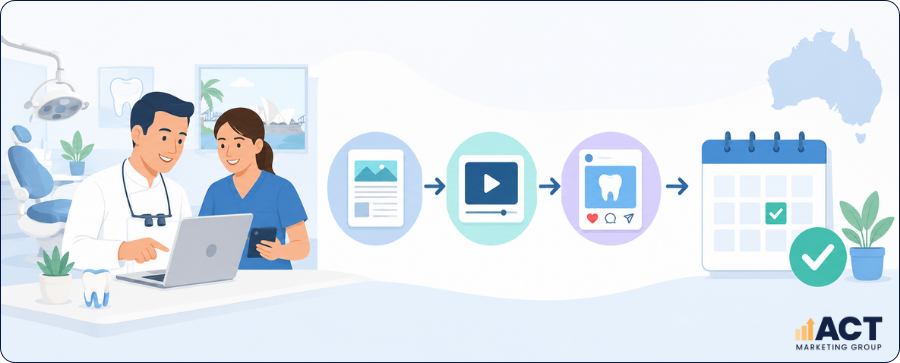
Strengthen Your Dental Content Marketing Strategy
Effective dental content marketing combines useful information, search visibility and a clear understanding of how potential patients make decisions. Blogs can answer detailed questions, short videos can explain unfamiliar processes, social posts can extend useful information, and local SEO can help connect that content to people searching for dental services nearby. For dental practices, the strongest approach is usually a focused one: identify the services and patient questions that matter most, create helpful content around those subjects, connect it to relevant service pages and measure whether it contributes to better search visibility and suitable patient enquiries. Your team can then improve what works rather than increasing content volume for its own sake.
ACT Marketing can support dental practices that want a more structured approach to dental SEO, content marketing and digital marketing. The goal is to build a practical dental marketing strategy that reflects your practice, supports appropriate patient decision-making and creates clearer pathways from search interest to enquiry.
Frequently Asked Questions
Dental practices can reach more targeted audiences by creating content around specific patient needs, services and local search behaviour. Instead of publishing broad topics for everyone, focus on the questions, treatments and locations most relevant to the patients your practice wants to attract.
Effective marketing for dentists should focus on useful patient information, local search visibility, clear service pages and practical booking pathways. The aim is to help potential patients understand the practice and its services without relying on exaggerated claims or unnecessary promotional pressure.
A content strategy works more consistently when the team understands which patient questions, services and marketing goals each piece of content supports. Dentists, practice managers and marketing staff can then identify useful topics, review clinical information and keep messaging consistent across the website, video and social media.
Using different tiers of content can make planning more efficient. A practice might use detailed blog posts and service pages for high-value search topics, shorter videos for patient education, and brief social posts or practice updates for regular communication and visibility.
Useful, accurate and consistent content can help build authority by showing that the practice can explain dental topics clearly and responsibly. Over time, a strong library of educational content may also support search visibility and give potential patients more confidence when deciding whether to contact the practice.