

Dental Marketing Tools Stack for Clinics should connect every meaningful step from a first enquiry through to a booked patient appointment. For Australian dental practices, the main challenge is rarely a lack of dental marketing tools; it is making sure websites, forms, phone calls, online scheduling, CRM records and follow-up processes work together without creating extra administration for front desk teams.
Start With the Patient Journey Before Choosing the Tools
The strongest dental marketing setup begins with the real patient journey rather than a list of software products. Most dental practices receive enquiries through several digital channels at once, including organic search, local searches, paid ads, social media pages, Google Business Profile activity, online scheduling and direct phone calls. Mapping those entry points helps you see how potential patients actually move through your practice. It also prevents you from choosing most marketing tools based on features that appear useful but do not solve a clear operational problem.
Get a Customized Marketing Strategy for Your Business
Schedule a free consultation to discuss how our digital marketing solutions can help you reach more customers.
Build CRM Stages Around Clear Patient Actions
Once the patient journey is mapped, the next step is to create CRM stages that represent real changes in enquiry status. A useful dental marketing pipeline should make it immediately clear what has happened, who owns the next action and whether the patient is moving towards an appointment. Avoid vague labels that require staff interpretation. Terms such as "hot lead" or "warm prospect" may sound familiar in general digital marketing, but they are less useful for dental practices than stages based on actions such as contacted, appointment offered or appointment booked.
These stages can be adapted to the practice's service mix. An emergency dentist enquiry may move rapidly from first contact to appointment, while enquiries involving more complex dental services may take longer and require several conversations before a booking is suitable.
Keep Every Enquiry in One Reliable System
After the stages are defined, the CRM should become the central place for tracking marketing-generated enquiries. Without one reliable record, enquiry information can be spread across emails, website notifications, reception notes and phone messages, but the CRM should collect and retain only the personal or health information reasonably required for the practice's legitimate purpose and manage that information using appropriate privacy and access controls. Centralisation supports consistent communication and makes it easier to see whether enquiries are progressing. It can also reduce phone tag by showing the last contact attempt, the assigned team member and the next scheduled action.

Connect Marketing Sources to Real Appointment Outcomes
Once enquiries are centralised, the next priority is connecting each contact to the marketing source that generated it. This is where dental marketing becomes more useful for decision-making because the practice can move beyond counting clicks, website visitors or form submissions. A channel that creates more enquiries is not automatically the channel that creates more patient appointments. Proper tracking lets you compare how organic search, paid ads, local SEO, social media, direct mail and other channels perform after the initial enquiry.
Read our guide to Dental Website SEO to learn how stronger on-site optimisation can improve search visibility and support more relevant patient enquiries.
Preserve The Information That Explains Marketing Performance
Source data becomes more useful when the CRM also preserves enough campaign context to explain why different enquiries behave differently. For example, people searching for an emergency dentist may have much higher immediate intent than someone who has only started researching a broader dental service. This is where high intent searches, local searches and broader search engine results should be considered separately. A clinic may receive fewer enquiries from one search term or landing page, but those enquiries may produce a higher proportion of new patient appointments.

Use Follow-Up Tasks to Support Consistent Communication
Once a new enquiry is created, each open record should have either a completed outcome or a clear next action. Automated follow ups can help front desk teams stay organised, but they should support human communication rather than replace it. A CRM can create follow-up tasks, highlight overdue enquiries and trigger administrative reminders. These functions are particularly useful when the clinic receives a steady flow of enquiries across phone calls, forms and online scheduling.
A practical process can include:
Create the enquiry record automatically.
Assign it to the appropriate staff member.
Set the first contact task.
Record the result of each contact attempt.
Set the next action or close the enquiry.
The aim is consistency. Patients should not receive excessive messages simply because an automated workflow has been activated, and staff should remain able to adjust follow-up based on what the person has requested.
Separate Marketing Messages from Appointment Communication
As your dental marketing tools become more connected, it is important to separate promotional communication from practical appointment messages. Appointment reminders, booking confirmations and requested information serve a different purpose from marketing campaigns designed to attract new patients or promote dental services. This distinction also improves the patient experience. Existing patients may want automated reminders or two-way texting about patient appointments without wanting additional promotional communication.
Your systems should therefore distinguish between:
Appointment confirmations
Appointment reminders
Recall reminders
Requested follow-up information
Marketing communication
This separation also helps the practice manage consent and communication preferences appropriately. Commercial email and SMS marketing should only be sent where the practice has an appropriate basis for consent and should include accurate sender information and a working unsubscribe option, while purely administrative appointment reminders should remain separate from promotional content.

Keep Dental Advertising Language Measured
Marketing automation must follow the same advertising requirements as the rest of your dental marketing. Advertising should not contain false or misleading claims, imply guaranteed or unrealistic treatment outcomes, use unsupported comparisons, create an unreasonable expectation of benefit, or encourage unnecessary use of dental services, whether the content appears on a website, in paid ads, in email or inside an automated CRM message.
Patient reviews and testimonials require specific care under Australian health advertising rules. A dental practice must not use a review or testimonial about the clinical aspects of a regulated health service in its advertising, including statements about symptoms, diagnosis, treatment, treatment outcomes or a practitioner's clinical skills or experience. Reviews published independently on platforms the practice does not control are treated differently, but the practice should not republish or otherwise use a clinical testimonial to promote its services.
Treat Online Reputation as a Separate Marketing Function
Reputation management often sits beside CRM activity, but it should not be treated as the same thing. Review management focuses on monitoring and responding appropriately to online reviews, while the CRM focuses primarily on enquiry progression and patient relationships. Independent online reviews can contribute to a clinic's online reputation when patients compare local practices. Practices may have processes for requesting feedback, but any resulting review that comments positively on symptoms, diagnosis, treatment, outcomes or practitioner clinical skills must not be republished or used by the practice as advertising for regulated health services.
A measured approach can include:
Sending review requests through an approved workflow
Monitoring Google reviews regularly
Responding to third-party reviews only where appropriate, while avoiding engagement that could amount to using a clinical testimonial to promote the practice
Avoiding incentives that encourage selectively positive feedback, and ensuring any advertised gift, discount or other inducement connected with dental services includes clear and accessible terms and conditions
Keeping patient information private in responses
Online reputation is one part of patient acquisition, not a substitute for good service, effective local SEO or strong enquiry handling. It works best when combined with accurate listings, a clear Google Business Profile and consistent patient communication. Read our guide to Google Business Profile for Dentists to learn how an accurate, well-managed profile can support local visibility and relevant patient enquiries.
Have Questions?
We're Here to Help!
Use Local SEO To Support High-Intent Enquiries
For many dental practices, local SEO is one of the most important links between search visibility and patient acquisition. Patients search using location-based terms, service terms and urgent phrases, and the clinic needs to appear clearly in relevant search results. Search engine optimization can help a practice build visibility over time, while local SEO focuses more closely on geographically relevant searches. Both can support patient acquisition efforts, but their performance should ultimately be assessed by the quality and progression of enquiries they generate.
Examine our guide to Local SEO for Dental Clinics to see how stronger local search visibility can support a more consistent flow of relevant patient enquiries.
Compare Paid Advertising Against Booked Appointments
Paid advertising can generate enquiries quickly, but ad spend needs to be measured against more than clicks or form submissions. A campaign that appears efficient at the top of the funnel may be less attractive once you compare booked appointments and actual patient flow. The most useful paid media reporting connects advertising spend with CRM outcomes. This gives the practice a clearer view of whether paid ads are attracting prospective patients who are suitable for the services being promoted.
Build A Dental Marketing Tools Stack Around Measurable Patient Flow
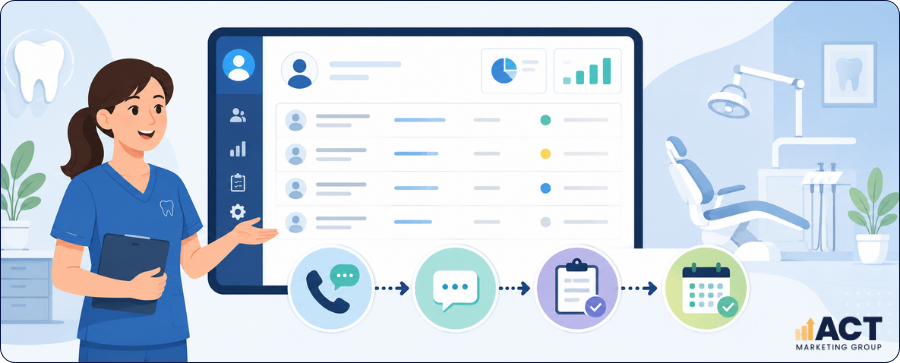
A useful dental marketing tools stack connects patient acquisition, enquiry handling, communication and appointment reporting in one clear process. For most dental practices, the priority should be a simple CRM pipeline, proper tracking, consistent follow-up and reliable reporting rather than adding every available platform. The strongest setup makes it easy to see where new patients come from, how enquiries progress and which marketing channels contribute to booked patient appointments. It also supports existing patients through practical reminders, clear communication and organised follow-up without relying on aggressive marketing.
ACT Marketing can help dental practices connect SEO, local SEO, paid advertising and other digital marketing activity to a measurable CRM pipeline. When your marketing strategy is tied to real patient flow and scheduled appointments, your team has a clearer basis for improving patient acquisition, controlling ad spend and making better decisions about future marketing investment.