

Landing Page Checklist for Vet Clinics starts with a straightforward goal: help the right pet owner understand your veterinary service and move towards an appointment without unnecessary friction. A landing page can attract visitors through search engines, Google Ads or other marketing channels, but traffic has limited value when people cannot quickly work out what your clinic offers, where you are located or how to book.
Start With the Appointment Your Landing Page Needs to Generate
Before changing your landing page headline, form fields or visual style, define the action the page needs to produce. A landing page for general veterinary consultations has a different target audience and conversion path from one focused on pet vaccinations, veterinary dentistry, desexing or another specific service. This decision establishes the value proposition for the entire page: what service you provide, who it is relevant to and what the visitor should do next. Without that focus, even a polished page can become a collection of competing messages rather than an effective landing experience.
Get a Customized Marketing Strategy for Your Business
Schedule a free consultation to discuss how our digital marketing solutions can help you reach more customers.
Match The Search Intent to the Primary Action
A useful page checklist starts by connecting visitor intent with one primary conversion. This message match matters whether visitors land on the page through organic search, Google Ads or another campaign. The closer the page reflects what the visitor was looking for, the less effort they need to spend finding relevant information.
Make The Hero Section Clear Within Seconds
Once the conversion goal is established, the hero section should make the purpose of the page immediately clear. A pet owner should be able to complete a simple blink test and understand the service, clinic or location and next step within a few seconds of arriving. The strongest landing page headline is usually specific rather than promotional. Instead of relying on broad statements about exceptional care, use a compelling headline that tells the target audience exactly what the page covers.
Build The First Screen Around Key Information
A practical hero section can include:
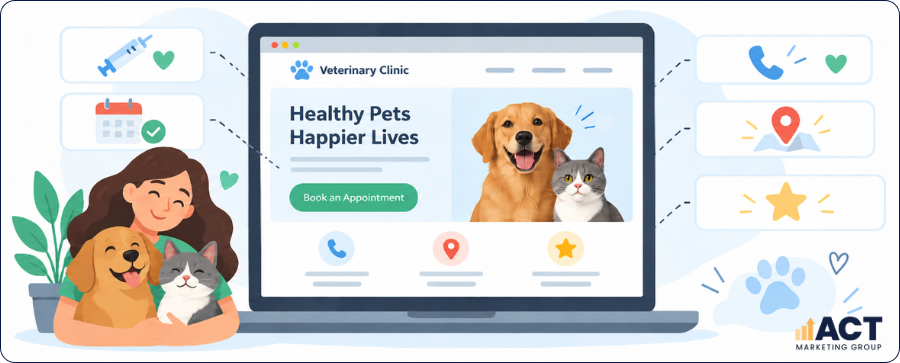
A clear, service-specific H1.
Your veterinary clinic name and location.
A concise value proposition.
One prominent CTA button.
A relevant clinic or veterinary team image.
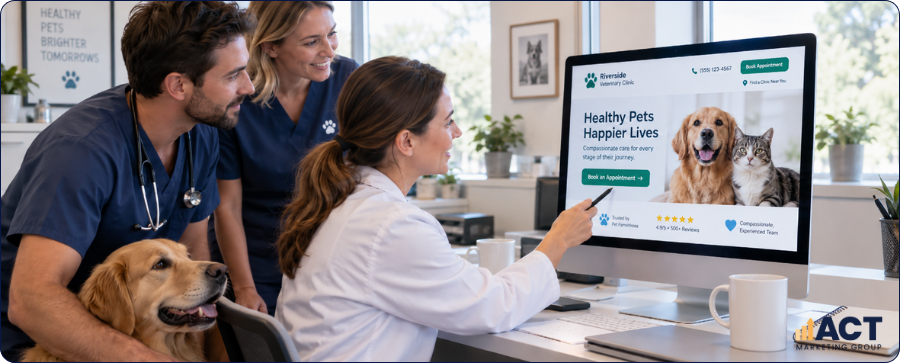
For example, “Veterinary Dental Care for Dogs and Cats in Canberra” tells a visitor considerably more than a headline such as “Giving Your Pet the Care They Deserve”. The supporting landing page copy can then briefly explain the service before encouraging visitors to request an appointment. A hero image should also have a practical purpose. Genuine images of your clinic, veterinary team or facilities are generally more informative than unrelated stock photos because they help visitors understand the practice they may be attending.
Build Trust Before Asking for a Booking
After the first screen establishes relevance, the next part of the conversion funnel should reduce uncertainty. Pet owners may want to understand who will be looking after their animal, what facilities are available, how the clinic approaches the service and what happens after they make contact. These trust signals should be factual rather than exaggerated. A high converting landing page does not need unsupported claims about being the leading or best clinic; it needs enough accurate information for visitors to decide whether your practice appears appropriate for their needs.
Want more practical ways to improve conversions? Read our guide to High-Converting Landing Pages for Vet Clinics for further ideas on page structure, messaging and booking pathways.

Choose Trust Signals That Add Useful Context
Social proof can form part of landing page design, but it should not overwhelm the practical information needed to make an appointment decision. If customer testimonials or other forms of social proof are used, they should be genuine, appropriately presented and reviewed against any advertising or professional requirements applying to the clinic. Client logos are common on business-to-business lead generation pages but are usually less useful for a veterinary service page. This is why a comprehensive landing page checklist should be adapted to the actual target audience rather than treating every conversion tactic as essential. Depending on the service, relevant trust signals can include:
Veterinary team names and professional roles.
Relevant qualifications or areas of clinical interest.
Photographs of the actual clinic and team.
Information about relevant diagnostic or treatment facilities.
Current address, opening hours and contact information.
Explain The Veterinary Service
Once visitors understand who you are, explain the service in enough detail to help them decide whether an appointment may be appropriate. The body copy should answer practical questions without turning the landing page into a clinical textbook. Plain language is particularly important because many pet owners will not use the same terminology as your veterinary team. Explain relevant procedures, assessments or next steps clearly while avoiding diagnoses, guaranteed outcomes or statements that may create unrealistic expectations.
Make The Call to Action Easy to Understand
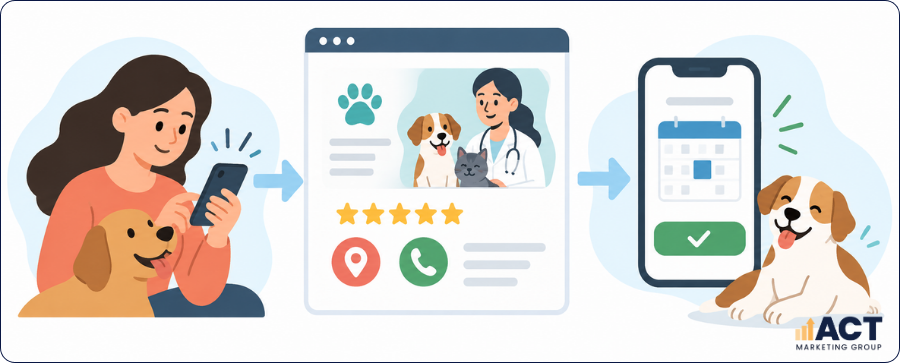
With the service and trust signals established, the next priority is making the appointment path obvious. Most landing pages perform better as user experiences when people are not asked to interpret several competing buttons or choose between vague actions. Use one main call to action throughout the page and keep the wording consistent. A CTA button labelled “Request A Vet Appointment” gives the visitor a clearer expectation than generic wording such as “Get Started” or “Learn More”.
Keep Form Fields Focused
Fewer form fields can reduce unnecessary effort, although the right form length depends on what your reception team actually needs. Avoid asking for information that staff can easily collect later unless it is necessary for managing the initial request. Multi step forms may be useful when a clinic genuinely needs additional information, but adding more steps solely to create a more sophisticated interface can work against simplicity. Whether you use a standard form, multi-step forms or an online booking system, the visitor should understand where they are in the process and what happens after submission. A first-contact form might request:
Owner name.
Phone number or email address.
Pet name and pet type.
Reason for the appointment.
Preferred day or time where relevant.
Design for Mobile Devices Before Assuming Desktop Works
The booking experience needs to remain clear on mobile devices. Mobile responsiveness affects how easily users can read landing page copy, tap a CTA button, enter information and contact your clinic without zooming, scrolling sideways or navigating around oversized elements. Mobile optimisation is therefore part of conversion design rather than a separate technical task. A great landing page on a desktop screen can still create poor landing page performance if its forms, images or buttons become difficult to use on a phone.
Protect Page Speed as You Add Visual Content
After the mobile layout is working, review page speed. Slow load times can make an otherwise effective landing page harder to use, particularly when visitors are on mobile connections or trying to find veterinary information quickly. Large hero images, unnecessary scripts, video backgrounds and excessive web apps can all add weight to a page. Landing page optimization should therefore balance visual presentation with a fast and stable experience.
Review The Elements That Commonly Slow a Page
A landing page builder can make page creation easier, but templates should still be reviewed carefully. Avoid assuming that a visually polished template automatically produces a fast, mobile responsive or high converting landing page. Your technical team or agency can test an existing page and identify which elements are contributing to slow load times. Improvements should then be prioritised according to their effect on usability rather than making technical changes without a clear purpose.
Connect The Landing Page with Local Search
Once the page works well for visitors, make sure search engines can also understand its purpose. Technical SEO and local relevance help clarify the connection between your veterinary service, practice and geographic area. Use the service and location naturally rather than repeatedly inserting the same phrases. Search visibility is more likely to be supported by a page containing useful information and a clear structure than one written primarily around keyword repetition.
Want to strengthen the technical foundation behind your landing pages? Read our guide to Technical SEO for Vets to see how site structure, crawlability, page speed and other technical factors can support stronger search visibility and a smoother user experience.
Check The Essential SEO Elements
For Google Ads landing pages, also check message match between the advertisement and the destination page. Someone clicking an advertisement about cat vaccinations should immediately reach content about cat vaccinations rather than being sent to a general homepage and expected to find the service themselves. The same principle applies to organic traffic. When visitors land from search engines, the page should deliver what the search result suggested it would provide.
Running Google Ads alongside your landing pages? See our guide to the latest Google Ads Updates for Vet Clinics and learn how clearer targeting, relevant service pages and better conversion tracking can support more meaningful appointment enquiries.
Set Up Conversion Tracking Before Judging Results
A successful landing page needs measurement as well as good design. Without conversion tracking, your clinic may know how many users visited the page without knowing whether those users called, submitted an enquiry or progressed towards an appointment. Google Analytics or another appropriate analytics setup can help track conversions and understand how people move through the landing page. The important point is to measure actions connected to clinic outcomes rather than treating more users or page views as the final objective.
Have Questions?
We're Here to Help!
Use a Comprehensive Landing Page Checklist Before Launch
At this stage, the individual components can be reviewed as one complete experience. A comprehensive landing page checklist helps your team identify small issues that may otherwise be missed when designers, marketers and clinic staff review only their individual areas. Rather than searching for an “ultimate landing page checklist” that applies equally to every business, evaluate the page against the needs of your veterinary clinic and target audience. A successful landing page should make the route from search to appointment easy to understand.
Message and Content
The page has one clear purpose.
The target audience is identifiable.
The landing page headline explains the service.
The value proposition is clear.
The landing page copy uses plain language.
Conversion and Trust
One primary call to action is clearly visible.
CTA button wording describes the next step.
Form length is appropriate.
Trust signals are accurate and relevant.
Clinic contact information is easy to find.
Design and Mobile Optimization
The hero section passes a basic blink test.
The page has a clear visual hierarchy.
White space separates key elements.
Mobile responsiveness has been tested.
Genuine clinic images are used where appropriate.
Technical SEO and Performance
Page speed has been tested.
Slow load times have been addressed.
The URL and metadata are clear.
Technical SEO elements have been checked.
Conversion tracking is active before campaigns begin.
Improve Your Vet Clinic Landing Page Around Real Appointment Behaviour
Use this landing page checklist to review one existing page at a time, starting with services that already receive meaningful search or advertising traffic. Look at message match, landing page copy, mobile responsiveness, page speed, form length, trust signals and conversion tracking together rather than trying to boost conversions through isolated design changes.
For veterinary clinics, landing page performance is most useful when it can be connected to genuine enquiries and appointments. ACT Marketing can help assess your existing landing pages, technical SEO, local search visibility and conversion funnel so your optimisation decisions are based on how visitors actually use the page rather than assumptions about what a successful landing page should look like.