

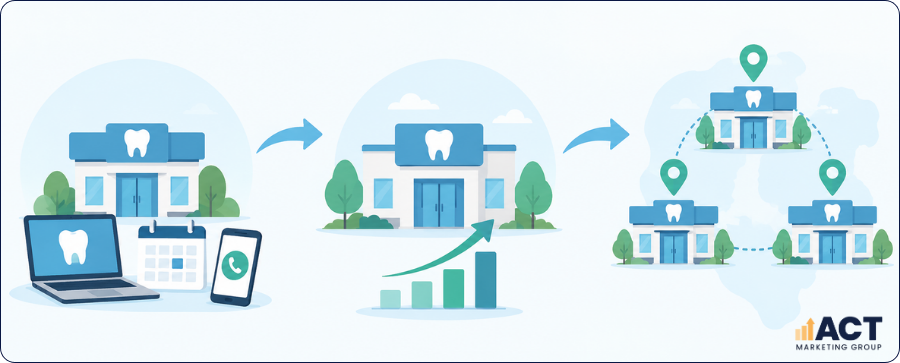
Dental Marketing Strategy by Growth Stage: Foundations, Expansion, and Multi-Clinic Scale requires different priorities as dental practices move from establishing local visibility to generating consistent demand and managing growth across several locations. A marketing approach that works for one practice with spare appointment capacity may not suit an established clinic trying to improve its treatment mix or a dental group coordinating several locations.
Start By Matching Dental Marketing to Your Growth Stage
Before choosing channels or increasing advertising spend, establish what the practice actually needs from marketing. A newer clinic may need a steady stream of new patients, while an established practice might need to increase demand for particular services, improve patient loyalty or use underfilled parts of the schedule more effectively. This distinction helps prevent a common problem: investing in online marketing before identifying the operational constraint. More patient inquiries do not automatically create stronger growth if the team cannot answer them effectively, appointment availability is limited or the marketing attracts prospective patients who are looking for services the clinic is not prioritising.
Get a Customized Marketing Strategy for Your Business
Schedule a free consultation to discuss how our digital marketing solutions can help you reach more customers.
Stage One Creates the Foundations for Local Patient Demand
Once the growth stage is clear, a developing practice should concentrate on becoming easy to discover and straightforward to contact. Most dental practices at this stage benefit more from strengthening core local search assets than from trying every available digital marketing channel at once. The priority is to create a reliable path from search engines to the practice website and then to an enquiry or booking. That usually means improving local SEO, your Google Business Profile, important dental services pages and the way potential patients find practical information about the clinic.
Want to improve how your dental practice appears in local search? Read our guide to optimising your Google Business Profile for Dentists and see which practical changes can support stronger local visibility and patient enquiries.
The right dental marketing strategies become more focused as the business matures. Each stage builds on the systems established before it rather than replacing them with another collection of disconnected marketing activities.
Strengthen Your Google Business Profile and Local SEO
Your Google Business Profile is one of the main places where patients search for information about a dentist in their local community. Practice details, opening hours, contact information, services and website links should therefore remain accurate and consistent. Local SEO should also make it clear where the practice operates and what it provides. Rather than creating pages around every possible suburb or set of relevant keywords, focus on useful pages that genuinely explain the practice, its location and the dental services available.
Online reviews can influence patient decisions on third-party platforms, but Australian dental advertising rules place specific restrictions on patient testimonials. Dental practices must not use testimonials about clinical aspects of a regulated dental service in advertising they control, including comments about symptoms, treatment provided, treatment outcomes, or a practitioner's clinical skills or experience. Comments limited to non-clinical matters such as customer service may fall outside the testimonial restriction where they do not refer to clinical aspects of care, but they must still not be used or presented in a false, misleading or deceptive way.
See how local SEO can help your dental clinic compete more effectively in your service area. Read our Local SEO Guide for Dental Clinics to see how practical search improvements can help more nearby patients find and contact your practice.
Turn Your Website into A Useful Patient Resource
Visibility only creates an opportunity. Your website still needs to help prospective patients understand the practice and decide whether taking the next step is appropriate for them. Educational content can support that process without relying on exaggerated or unsupported claims. Pages covering common dental care considerations, treatment processes, oral health tips and practical dental tips can educate patients while providing useful information about the clinic's dental services and areas of practice. A useful service page might explain:
What the treatment involves
Situations where it may be considered
What an initial consultation involves
Important suitability considerations
How patients can contact the team or schedule an appointment

Stage Two Moves from Generating Leads to Building Better Demand
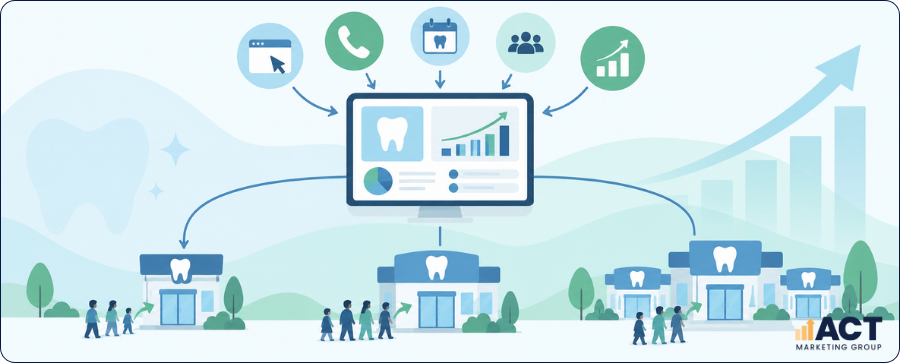
Once the foundation is generating a steady flow of patient inquiries, the next stage is not necessarily to increase marketing everywhere. Growing practices should determine which types of demand support current capacity, treatment priorities and the experience they want to provide to patients. For example, a practice may have room for more preventive appointments but limited capacity for emergency dentistry, or it may be developing a particular area of treatment and need more suitable consultation inquiries. At this point, dental marketing becomes more closely connected to practice operations.
Improve Conversion Before Paying for More Traffic
As the practice expands, improving the experience between website visit and appointment can become as important as attracting additional users. If potential patients reach the website but struggle to understand treatment options, find any pricing information the practice has chosen to publish or contact the office, additional ads may simply increase inefficient spending. Look at the full path from search to booked appointment. This helps identify whether the issue sits within marketing, the website, reception processes or appointment availability.
Lifetime patient value can provide useful context at this stage, but it should not be treated as a reason to maximise acquisition costs without limits. The lifetime value of a patient depends on their needs, treatment decisions, retention and the quality of patient care over time.
Add Internal Marketing to Support Sustainable Growth
Once acquisition is working reasonably well, external marketing should not operate in isolation. Internal marketing can support retention by helping existing patients understand available services, maintain appropriate recall routines and stay connected with the practice. This can include educational emails, oral health information, reminders and clear explanations of relevant services. The purpose is not to pressure patients into treatment, but to make appropriate information available and improve continuity of care where suitable.
Build Compliance Checks into Every Marketing Campaign
As marketing activity expands, the number of pages, ads, social media posts and campaigns usually increases. Dental practices therefore need a repeatable review process rather than relying on individual team members to recognise every possible advertising issue. Advertising for regulated dental services must not be false, misleading or deceptive, use prohibited testimonials, create an unreasonable expectation of beneficial treatment, or directly or indirectly encourage the indiscriminate or unnecessary use of regulated health services. If an advertisement offers a gift, discount or other inducement to attract a person to use the regulated health service or business, the advertisement must state the terms and conditions of the offer.
Social media can support your dental practice when it is used with a clear purpose. Explore our Guide to Social Media Marketing for Dentists for practical ideas on content, consistency and patient communication.
Stage Three Turns Marketing into a Multi-Clinic System
When a dental business grows beyond one practice, the marketing challenge changes again. Multi-clinic groups need consistency across the wider business while recognising that individual clinics can have different patients, competitors, appointment capacity and service priorities. Copying the same page, ads and local SEO strategy for every location rarely accounts for those differences. A scalable approach creates common standards for the brand, website, measurement and compliance while allowing each clinic to respond to its own local market.
Have Questions?
We're Here to Help!
Give Each Practice a Clear Local Search Presence
Each clinic should have a useful location page with accurate contact details, opening hours, team information and locally relevant dental services. Where research shows genuine demand, additional service content may be created for a location, but it should provide useful information rather than simply changing suburb names across otherwise identical pages. The marketing priorities of each clinic may also vary. One practice may need more general dentistry bookings while another has greater capacity for a particular treatment, so budget allocation should reflect those conditions.

Build a Dental Marketing Strategy Around Your Next Growth Stage
Dental marketing strategies should change as the practice develops. A clinic establishing its foundations needs strong local SEO, a useful website, a complete Google Business Profile and clear booking pathways; an expanding practice needs closer alignment between marketing, capacity and service demand; and a multi-clinic business needs consistent systems with appropriate local flexibility. The next step is to identify the current constraint before trying to generate more patients. ACT Marketing can help dental practices assess search visibility, patient acquisition, service priorities and digital marketing performance, then create a strategy that reflects the practice's actual growth stage rather than applying the same marketing plan to every clinic.