

A Dental Landing Page Checklist for Compliance and Clarity: Claims, Offers, and Contact Paths helps Australian dental practices build landing pages that communicate services clearly while reducing avoidable advertising and patient communication risks. High converting landing pages still need accurate claims, understandable offers and contact paths that reflect what happens next in the patient journey.
Start With the Overall Message Patients Receive
Before reviewing individual words, look at the entire page and consider the message a patient is likely to take away. The landing page copy, images, prices, buttons and layout work together, so an individual sentence that appears reasonable can still contribute to a misleading overall impression. This is also where a clear value proposition matters. For a dental practice, a strong value proposition should explain the service, the practice approach or the next step clearly rather than claiming superior treatment outcomes that cannot be supported.
Most landing pages are reviewed heavily for conversion rate and design. Dental landing pages need an additional layer of review because the conversion goal should never come at the expense of clear and responsible healthcare advertising.
Get a Customized Marketing Strategy for Your Business
Schedule a free consultation to discuss how our digital marketing solutions can help you reach more customers.
Review Every Clinical Claim Before Improving The Sales Message
Once the overall message is clear, examine statements about results, comfort, safety, speed, appearance and longevity. Benefit-focused copy can be useful, but it still needs to distinguish between explaining a potential benefit and suggesting that a particular outcome will happen for every patient. Words such as "permanent", "pain-free", "risk-free", "guaranteed" or similar absolute claims require particular care. A high converting landing page does not need to promise certainty; it can speak directly to the target audience by explaining what the treatment is designed to address, how assessment works and which individual factors may affect suitability or outcomes.
Keep The Page Focused Without Telling Patients They Need Treatment
After reviewing claims, check whether the landing page moves too quickly from describing a problem to suggesting that a particular procedure is necessary. Effective landing pages can have a singular focus while still recognising that dental treatment decisions depend on the individual patient's circumstances. For example, a page about dental implants can explain why patients may explore tooth replacement and what an implant consultation involves. It should avoid implying that every person with a missing tooth needs an implant or that one treatment option is automatically appropriate without assessment. Useful body copy can explain:
What the service generally involves.
Why a patient may consider discussing it with a dentist.
Factors that can affect treatment suitability.
What happens during an initial consultation.
Whether other options may need to be considered.
This approach gives the page a clear conversion goal without turning marketing copy into a treatment recommendation.
Check Offers and Promotions Before Using Them as Conversion Tools
Offers are often placed in the hero section because they direct attention quickly, but prominence makes clarity particularly important. If a dental landing page advertises a discount, gift or other benefit, potential customers should be able to understand the important conditions without searching through the site.
A strong landing page should not rely on vague wording such as conditions apply while material information remains difficult to locate. If advertising offers a gift, discount or other inducement to attract patients, the terms and conditions of the offer must also be stated. Where full terms are provided elsewhere, the landing page should clearly direct visitors to an easily accessible location containing those terms rather than requiring them to search for the information or contact the practice.

Make Important Offer Conditions Easy to Understand
Use this page checklist whenever a promotion appears:
Eligibility: Identify who can access the offer.
Dates: State when the promotion begins and ends where relevant.
Inclusions: Explain what the advertised amount or benefit covers.
Exclusions: Identify important services or costs that are not included.
Suitability: Make clear where treatment remains subject to assessment.
Creating urgency should be approached carefully in dental advertising. Countdown timers, "act now" language or repeated prompts designed mainly to create pressure may encourage users to act before they have considered whether the service is appropriate.
Make Pricing Clear from the First Relevant Reference
Pricing should be reviewed alongside promotions because a prominent figure can shape the entire value proposition. Whether the page uses an exact price, "from" price, consultation fee or payment amount, visitors should understand what that figure means. A high converting landing page can still be commercially clear without oversimplifying treatment costs. If the final cost depends on assessment, treatment complexity or additional procedures, the landing page copy should make that limitation understandable rather than presenting a starting figure as though it applies to the entire treatment.
Check whether:
"From" prices have a reasonable basis.
What is included in the price is clear.
Significant exclusions are visible.
Payment amounts are not presented as the total treatment cost.
Health fund information avoids implying a guaranteed rebate.
Clear pricing can also improve the user-friendly experience after visitors land on the page. Reception staff are less likely to need to correct assumptions created by unclear advertising, and patients arrive at the enquiry stage with a more realistic understanding of what has been advertised.
Treat Testimonials and Social Proof with Particular Care
For many modern businesses, social proof such as customer testimonials, customer logos or video testimonials is commonly used on high converting pages. Dental advertising is different because testimonials or purported testimonials about clinical aspects of a regulated health service must not be used in advertising.
Do not assume common landing page builder templates are suitable simply because they include review sections. Patient reviews, screenshots, stories or video testimonials referring to symptoms, diagnosis, treatment, outcomes or practitioner skills should not appear in practice-controlled advertising. Comments limited to non-clinical matters such as customer service may not be testimonials, but they should still be checked to ensure they are not misleading. Instead, build confidence using factual information such as:
Accurate practitioner information.
Clear explanations of the treatment process.
Clinic location and accessibility information.
Relevant opening hours.
Straightforward descriptions of available services.
Generic stock photos may support page design, but they should not imply that the person shown is a patient who achieved the advertised result. Additional Ahpra advertising requirements apply to higher-risk non-surgical cosmetic procedures, including dental veneers. For these services, images should not create unrealistic expectations or imply treatment outcomes that are not represented accurately. Practices promoting these procedures should also review the additional requirements applying to risks, imagery and advertising directed towards people under 18.
Want a broader view of compliant dental marketing? Read our guide to AHPRA-Compliant Dental Marketing for practical guidance on promoting your practice online while keeping claims, SEO content and patient-facing information aligned with current advertising requirements.

Present Practitioner Information as a Factual Trust Signal
Once unsuitable social proof has been removed, practitioner information can provide useful context for someone deciding whether to make an enquiry. Credentials, professional roles and relevant areas of practice can function as trust signals when they are presented accurately and without unnecessary claims of superiority.
If a dentist who is not a registered medical practitioner uses the title Dr or Doctor in advertising, their registered profession should also be made clear, for example Dr Jane Smith, Dentist. Specialist titles, qualifications and descriptions must accurately reflect the practitioner’s registration and must not imply specialist registration that they do not hold.
Avoid converting practitioner information into unsupported superiority claims. Terms such as best, leading or similar comparative claims may be misleading unless the practice has adequate evidence to support the specific representation being made. Clear information about registration, qualifications, relevant experience and services is generally more useful to potential patients.
Guide Visitors Towards the Right Contact Path
After the content itself has been reviewed, assess what visitors can actually do next. The primary CTA button should reflect the genuine next step instead of implying that treatment has already been recommended or approved. For example, "Request A Dental Implant Consultation" is usually clearer than "Book Your Dental Implants" when assessment is still required. The first option guides visitors towards an appropriate conversation, while the second may suggest that a clinical decision has already been made.
Keep navigation menus and secondary buttons from competing unnecessarily with the main conversion goal. A clear visual hierarchy should direct attention to the main action while still allowing visitors to reach essential practice, privacy and contact information.

Keep Forms Simple Without Collecting Too Much Information
Clear contact paths lead directly to another important part of the landing page checklist: forms. Short forms can reduce unnecessary effort for the visitor, but the practice should also consider what information genuinely needs to be collected at the first point of contact.
A basic lead generation form may only need a name, contact details and a simple enquiry field. Asking for detailed health information before it is reasonably necessary can increase the practice’s privacy obligations, particularly where the information reveals health or treatment concerns.
Simple forms can support both clarity and conversion. Collect only information reasonably required for the next step and provide an appropriate privacy collection notice where required, including information about why personal information is being collected and how it will be handled.
Protect Page Speed and Mobile Usability
Compliance and clarity will have less effect if visitors leave before they can read the page. Page speed and mobile optimisation therefore belong in the practical review, particularly when landing pages receive traffic from Google Ads, organic search or mobile users. Slow load times, oversized hero images and unnecessary video content can cause visitors to leave before reaching important treatment information or the primary CTA button. Mobile responsiveness should also be checked manually so important conditions, offer details and buttons remain readable on smaller mobile devices.
Fast load speed supports a user-friendly experience, but technical SEO and page performance should not be treated as substitutes for accurate copy. The content and the technical experience need to work together. A well-built landing page still depends on a strong technical foundation. Explore our guide to Technical SEO for Dental Websites to see how site speed, mobile performance, crawlability and structure can support stronger search visibility.
Maintain Message Match from Traffic Source to Landing Page
Once page performance is reliable, review message match between the traffic source and the page itself. Someone clicking a Google Ads message about an implant consultation should arrive on a page that clearly discusses that consultation rather than a generic dental homepage covering the entire business. Strong message match reduces confusion and helps guide visitors through the conversion funnel. It also makes it easier to maintain a singular focus because the landing page headline, hero section, body copy and call to action can all address the same service and target audience.
Have Questions?
We're Here to Help!
Measure Performance Without Removing Essential Information
After publication, conversion tracking can identify whether visitors complete forms, call the clinic or reach key booking steps. These measurements can help identify underperforming pages, but conversion rate should be considered alongside the quality and appropriateness of the enquiries generated.
Avoid interpreting every drop in conversions as a reason to remove qualifications, offer conditions or important treatment information. Landing pages convert more effectively over time when optimisation focuses on genuine friction, such as confusing navigation, slow load times, unclear forms, weak message match or calls to action that do not match visitor intent.
Useful optimisation areas include:
Landing page headline clarity.
Page speed and mobile responsiveness.
Form completion.
CTA visibility.
Enquiry quality.
These practical tips can help boost conversions without turning the page into increasingly aggressive sales copy.
Use A Final Landing Page Checklist Before Publication
The final stage is to turn all of these checks into a consistent internal process. Every new dental landing page and significant revision to an existing page should pass through a documented review before publication. This makes responsibilities clearer between the practice, clinicians and marketing team. It also helps prevent later landing page optimisation from accidentally removing essential elements or adding claims that have not been reviewed.
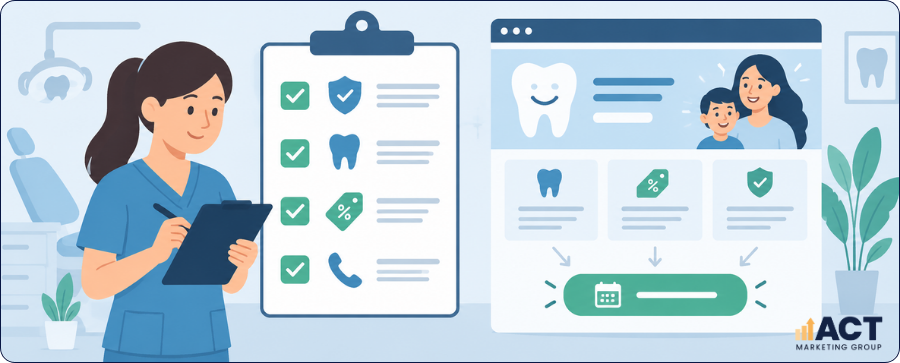
Dental Landing Page Pre-Publish Checklist
A landing page builder can make publishing easier, but it cannot determine whether dental advertising is appropriate for a specific practice. Human review remains essential before the page goes live and whenever significant claims, promotions, prices or patient pathways change.
Build Dental Landing Pages Around Clarity and Appropriate Next Steps
A useful landing page checklist brings compliance, patient clarity and conversion design into the same review process. High converting pages do not need exaggerated claims, hidden conditions or pressure-based offers; they need a clear value proposition, accurate landing page copy and a logical path from the visitor's initial question to the next appropriate step.
ACT Marketing can use this compliance-aware foundation to improve dental landing page optimisation, search visibility, Google Ads message match and conversion paths while maintaining a restrained and practical approach to healthcare marketing. This article provides general marketing and operational information and is not legal advice. Dental practices should confirm the requirements applying to their own advertising, services and circumstances before publication.